
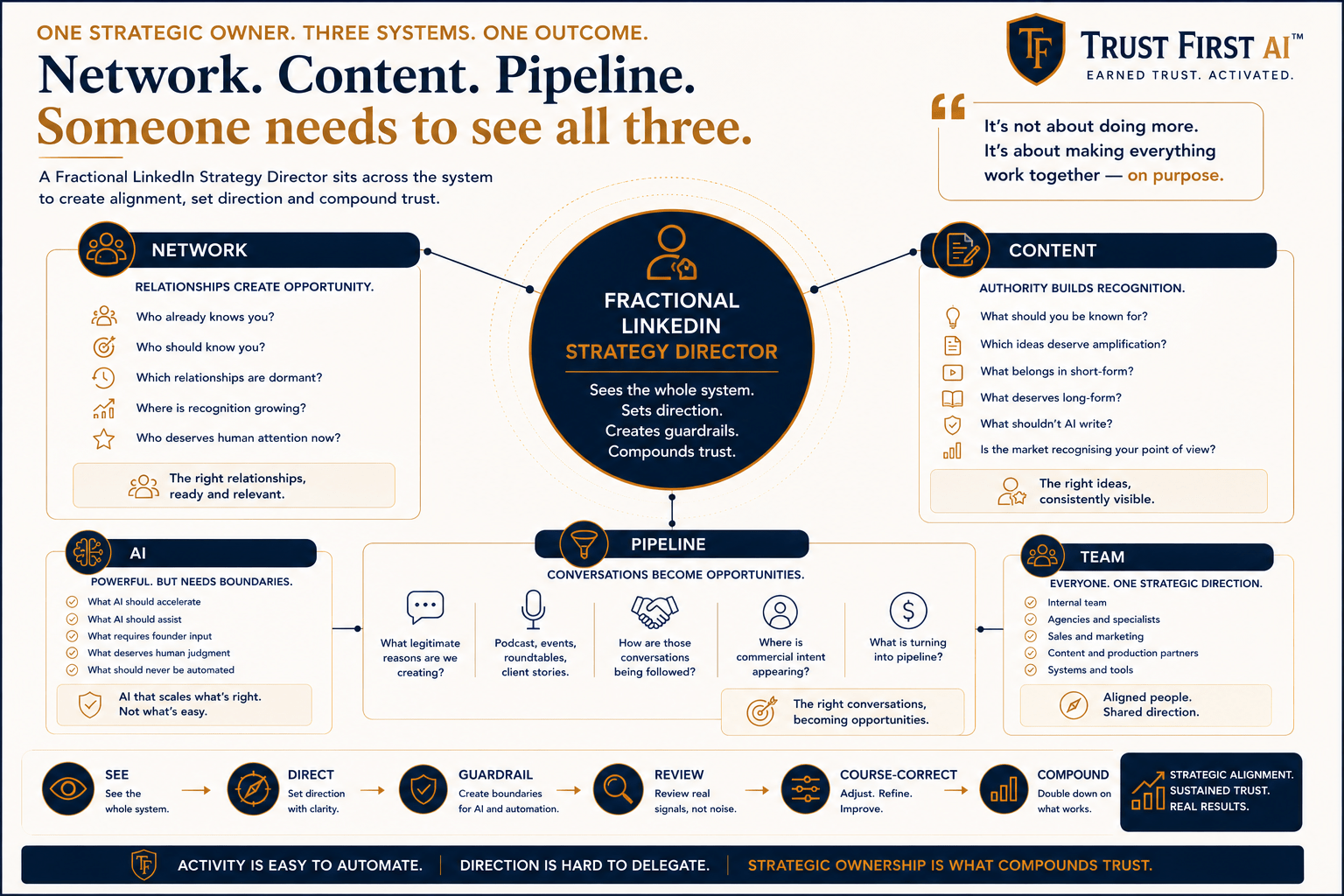
But who’s sitting across the whole thing asking:
A Fractional LinkedIn Strategy Director provides senior strategic ownership across the system — without adding another full-time executive to the team.
You might already have a content agency producing posts, a podcast team producing episodes, a VA managing connections, sales following up, marketing running campaigns, a CRM storing contacts, AI tools automating pieces, and the founder jumping in wherever something feels important.
None of those things is necessarily wrong.
The problem appears between them.
Everyone owns a piece. Nobody owns the trust system.
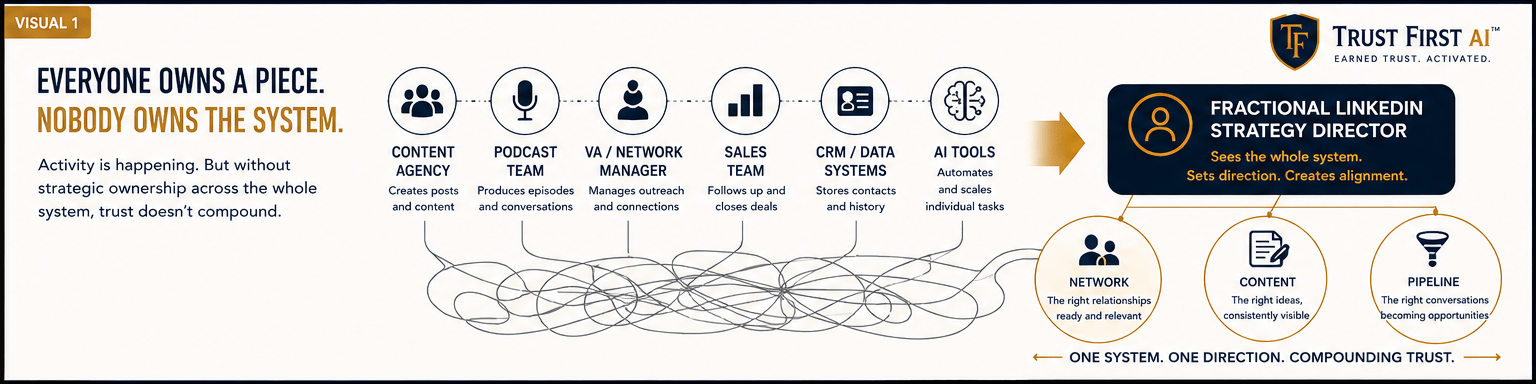
LINKEDIN MANAGEMENT ASKS
LINKEDIN STRATEGY DIRECTION ASKS
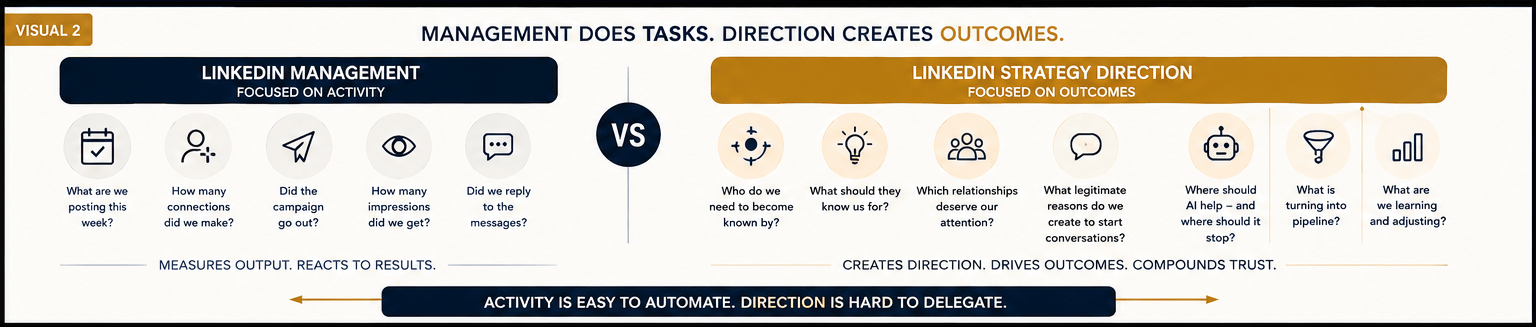
The Fractional Director doesn’t replace these systems. The Fractional Director makes sure they behave like one.
Who already knows you? · Who should know you? · Which relationships are dormant? · Where is recognition growing? · Who deserves human attention now?
What should the founder be known for? · Which ideas deserve amplification? · What belongs in short-form? · What deserves long-form? · What shouldn’t AI write? · Is the market beginning to recognise a point of view?
What legitimate reasons are we creating for people to engage? · Podcast · Roundtable · Client story · Event · Introduction · Conversation · How are those conversations being followed? · Where is commercial intent appearing?
Without strategic ownership, every team member can now automate more.
More content. More messages. More sequences. More research. More personalisation. More activity.
That’s powerful.
It’s also dangerous when nobody owns the boundaries.
The Fractional Director decides what AI should accelerate, what AI should assist, what requires founder input, what deserves human judgment, and what should never be automated.
You don’t need less AI. You need AI that knows what not to automate.
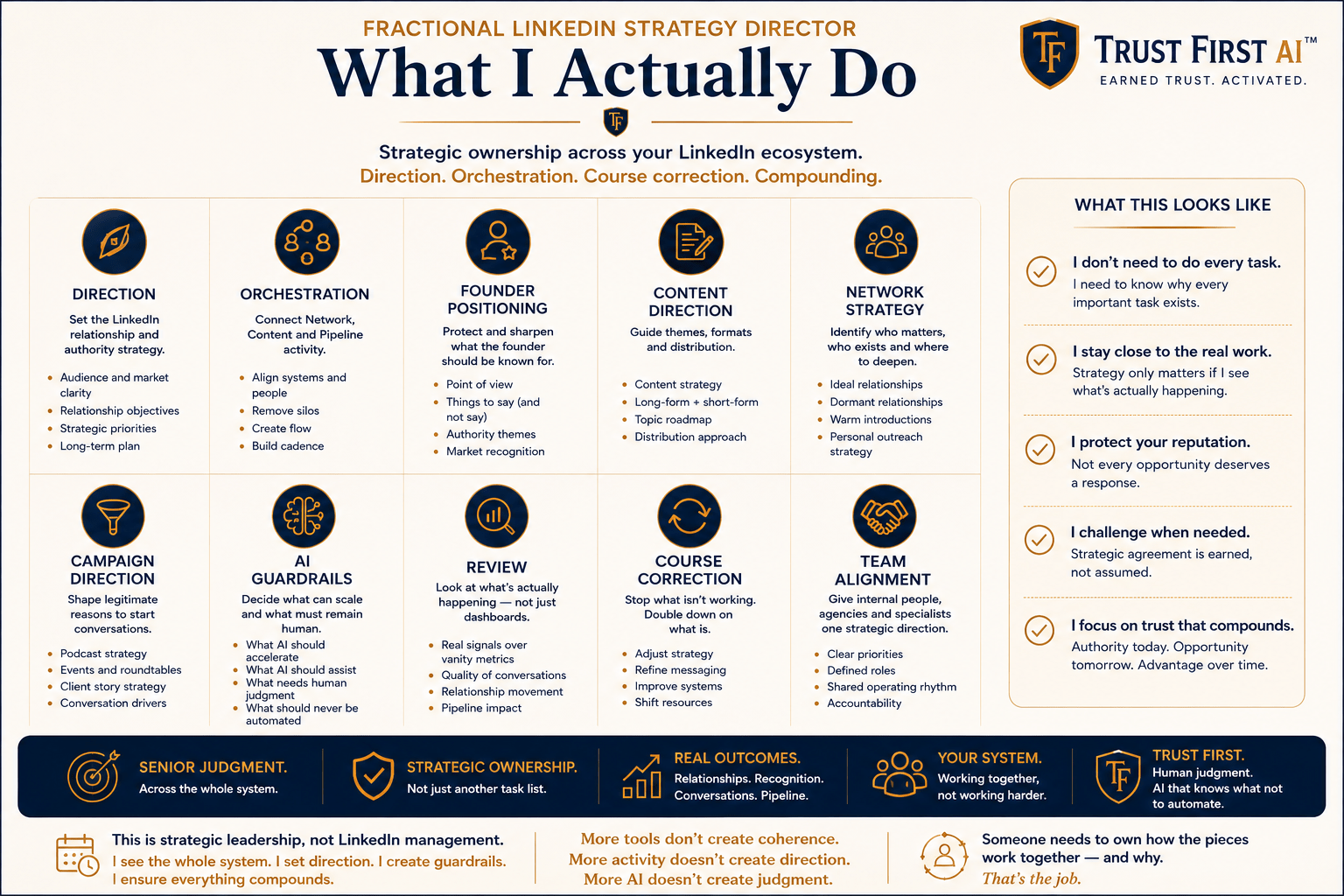
Set the LinkedIn relationship and authority strategy.
Connect Network, Content and Pipeline activity.
Protect and sharpen what the founder should become known for.
Guide themes, formats, long-form assets and distribution.
Identify who matters, who already exists and where relationships should deepen.
Shape the legitimate reasons used to start conversations.
Decide what can scale and what must remain human.
Look at what’s actually happening — not just dashboards.
Stop what isn’t working. Double down on what is.
Give internal people, agencies and specialists one strategic direction.
I don’t exist to approve commas, fill a content calendar, celebrate impression counts, send thousands of automated messages, force every relationship into a sequence, replace your sales director, replace your marketing team, or replace specialist partners who are already good at what they do.
Instead: I sit across the pieces that affect how the market experiences, recognises and trusts the founder.
Over that relationship, the ecosystem has included LinkedIn strategy, network development, founder positioning, the Smells Like Money podcast, newsletters, content, relationship activation, campaigns, CRM/data, follow-up, industry conversations, client proof and AI-supported systems. The important point isn’t that every element ran from day one. It’s that there was strategic continuity across them.
Selected proof:
Within the newer Give-First window:
Commercial authority progression:
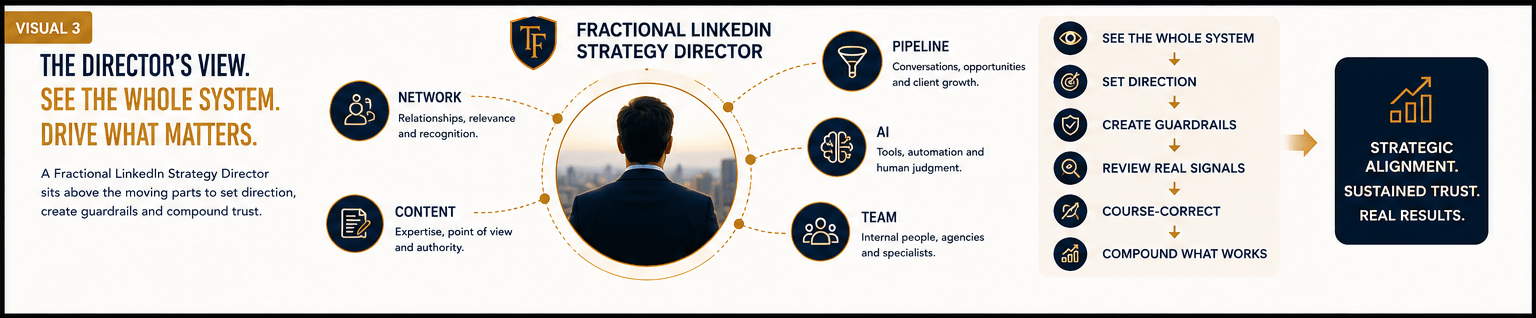
The Director sits across Network, Content, Pipeline, AI and Team. The operating rhythm is:
The goal is strategic alignment, sustained trust and real results.
This role makes sense when:
You don’t need this because your LinkedIn profile needs fixing. You need it when LinkedIn has become strategically important enough that somebody should own the whole picture.
And I don’t want to be. A Fractional LinkedIn Strategy Director sits unusually close to your business.
I may see your network. Your client relationships. Your pipeline. Your content before it becomes public. The conversations you’re trying to create. The opportunities you’re pursuing. And sometimes the things I believe you shouldn’t do.
That requires more than a commercial agreement. It requires trust in both directions.
Have already earned something worth building around · Want strategic challenge, not just agreement · Are willing to play the long game · Will protect the human side of the system · Are prepared to participate · Care about reputation as much as reach · Are comfortable learning and course-correcting
You should be comfortable giving me access to the strategic picture. You should expect me to challenge assumptions. You should understand that I won’t recommend activity simply to justify a retainer. And you should believe, as I do, that your reputation is an asset we are there to compound — not spend.
Some businesses need a focused Network system. Some need Content. Some need Pipeline. Some should start with a Pilot.
And sometimes I’ll simply tell you:
“I don’t think you need a Fractional LinkedIn Strategy Director.”
That’s a perfectly good outcome.
The goal is to find the few where strategic ownership can genuinely matter.
Network · Content · Client proof · Pipeline · People · Tools · AI · Current activity
What’s working? · What’s disconnected? · What’s duplicated? · What’s risky? · What’s missing?
What needs intervention now? · What can wait? · What should stop?
Create the strategic operating rhythm.
Learn from actual activity and build around what works.
Someone needs to understand the founder, the market, the relationships, the content, the pipeline, and the reputation connecting all of them.
That’s the job.
Start with the Trust Asset Clarity Session.
We’ll look at your Connections, Content and Clients, identify what’s disconnected and determine whether the problem needs a focused mechanism — or strategic ownership across the whole system.
You don’t need less AI. You need AI that knows what not to automate.