
A structured LinkedIn invitation and event activation campaign that fills your webinar, workshop or LinkedIn Live event with the right people — built on the trust you’ve already earned, not paid reach.
You put real thought into the content. You built the event page, shared it with your audience and waited for registrations.
But a good event with the wrong room is still the wrong event.
Too often, attendance depends on whoever happens to see the posts, existing clients and colleagues, or people who were never really the buyers the event was designed for.
Meanwhile, your LinkedIn network may include hundreds — often thousands — of people who said yes to connecting with you at some point.
Your buyers may already be in there.
They just haven’t been given a well-timed, well-framed reason to show up.
An invitation from someone they already recognise lands very differently from a paid ad or a mass blast.
The trust is already there.
What’s missing is the system that carries it into a room full of the right people. Sending invitations isn’t the hard part.
The system is simple from the outside. Behind it is careful selection, context and timing.
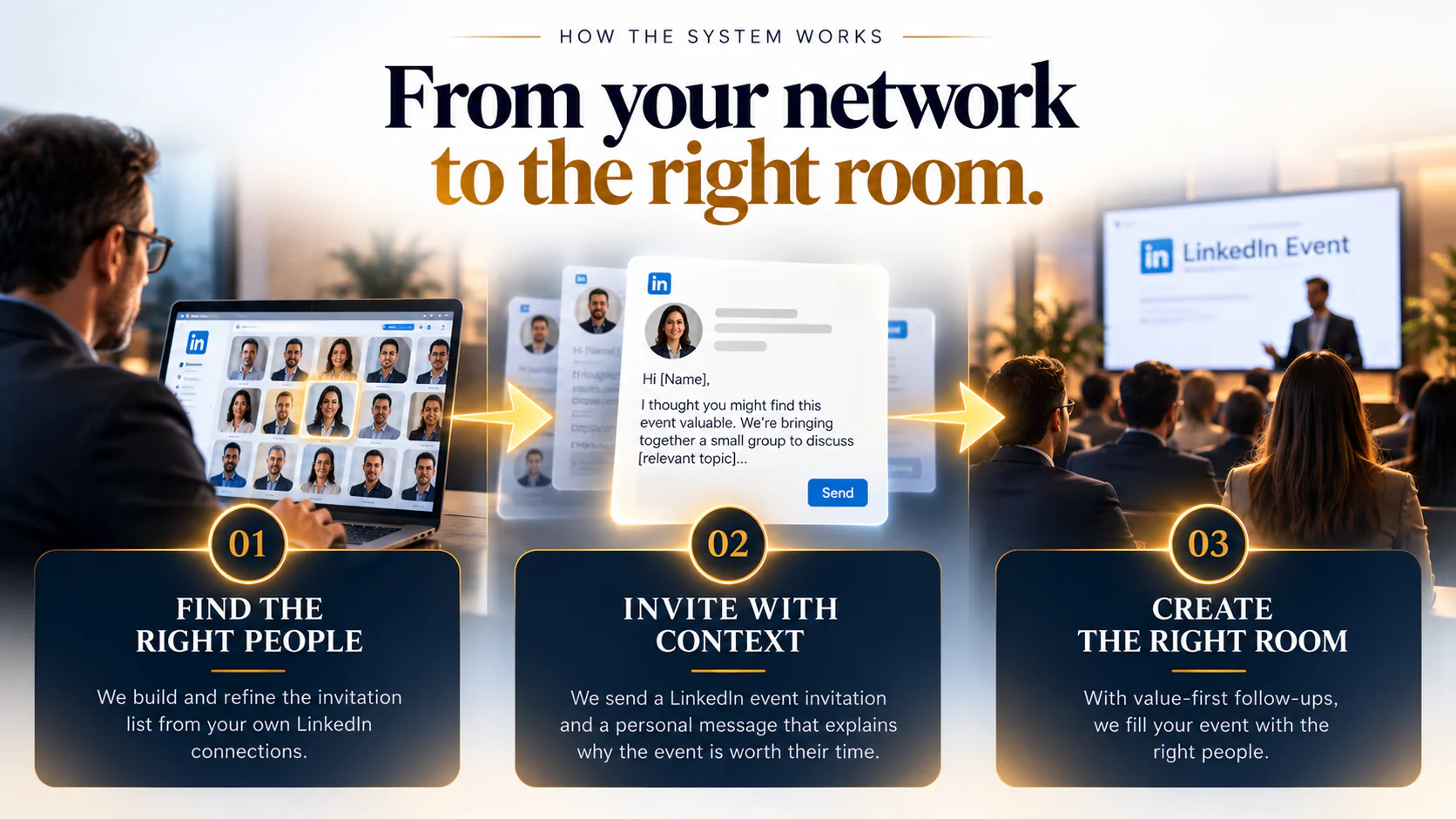
Before a single invitation goes out, we work with you to define exactly who should be in the room.
Then we build and refine the invitation list from your existing LinkedIn network — using role, company, industry, location and the specific relevance of your event topic.
The objective isn’t the biggest possible list.
It’s the right list.
The right people receive the LinkedIn event invitation.
But we don’t rely on a notification alone.
They also receive a personal invitation explaining why the event is relevant and worth their time.
The event invitation creates awareness.
The personal message provides the context.
People who haven’t responded can receive up to two value-first follow-ups.
Not repeated reminders.
Useful reasons to reconsider the invitation.
The campaign runs at a measured pace and stops when someone responds.
The result is an event built around relevance rather than reach.
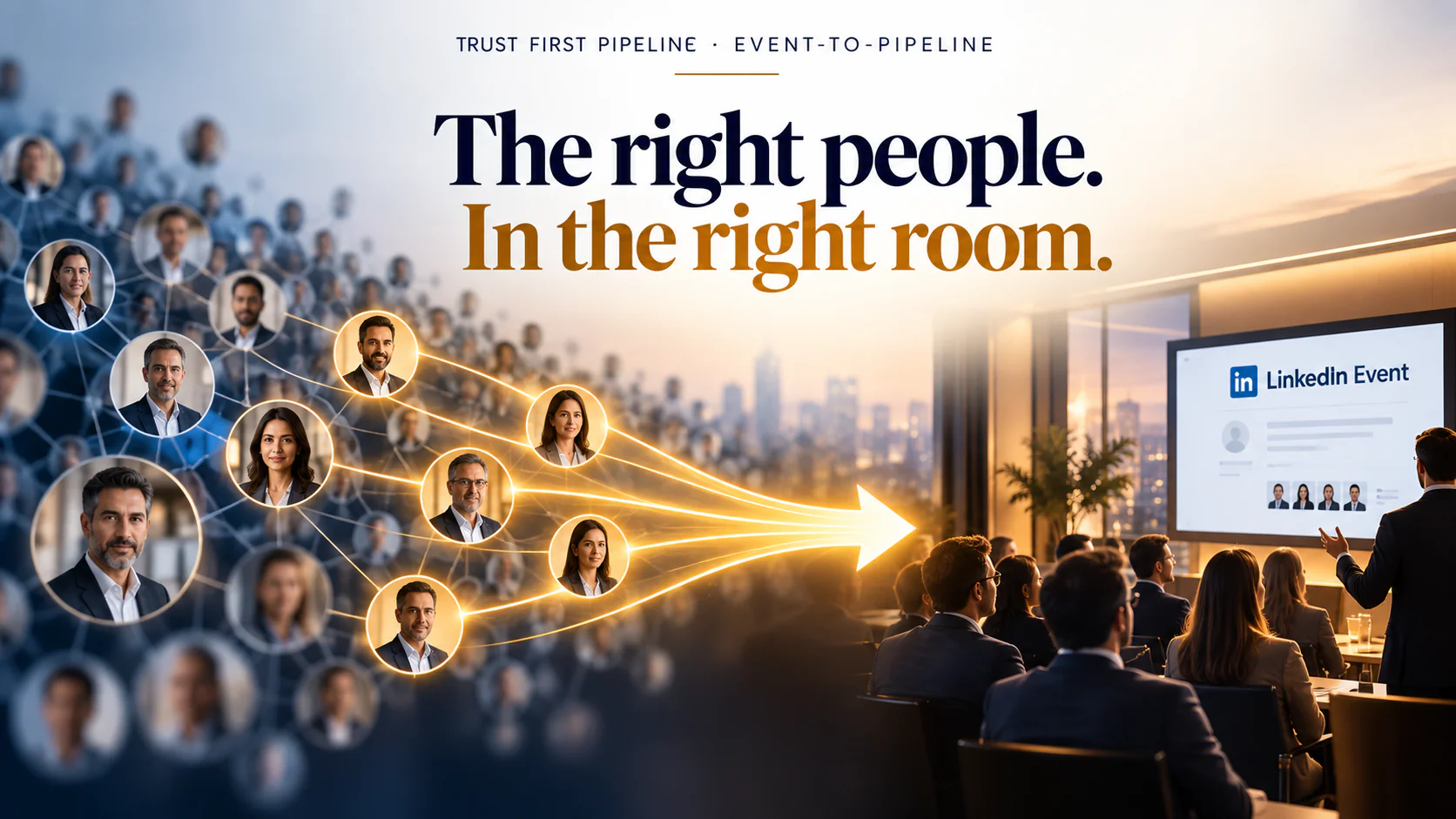
The right people. In the right room.
A working session to define exactly who the event is for and who should be invited from your existing network. This is the most important step in the campaign.
Invite up to 750 or 1,500 relevant people from your network, depending on the campaign size.
A personal LinkedIn invitation explaining why the event is relevant, followed by up to two value-first follow-ups where appropriate. Replies are captured as the campaign runs.
A shared activity sheet updated throughout the campaign with invitations sent, replies received, names and LinkedIn profiles. You can see what is happening as it happens.
3–4 LinkedIn posts across the campaign — including the announcement, topic-led posts and the final countdown.
We write the event page copy and help establish the event experience. LinkedIn Live can provide a simple one-click attendance experience with an automatic replay. If your event needs registration, greater interaction or a different format, we can work with your existing webinar platform instead.
Day-before and hour-before reminder copy so registrants have another reason to show up.
Within 48 hours, you receive a breakdown of who attended, the responses generated during the campaign and the people showing meaningful interest. Where relevant, those people are identified with a suggested next step.
People who registered but couldn’t attend can receive the replay, giving the event another opportunity to create engagement after the live session ends.
Creative Raven · Suzan Chin-Taylor · Wastewater & Infrastructure · May 2026
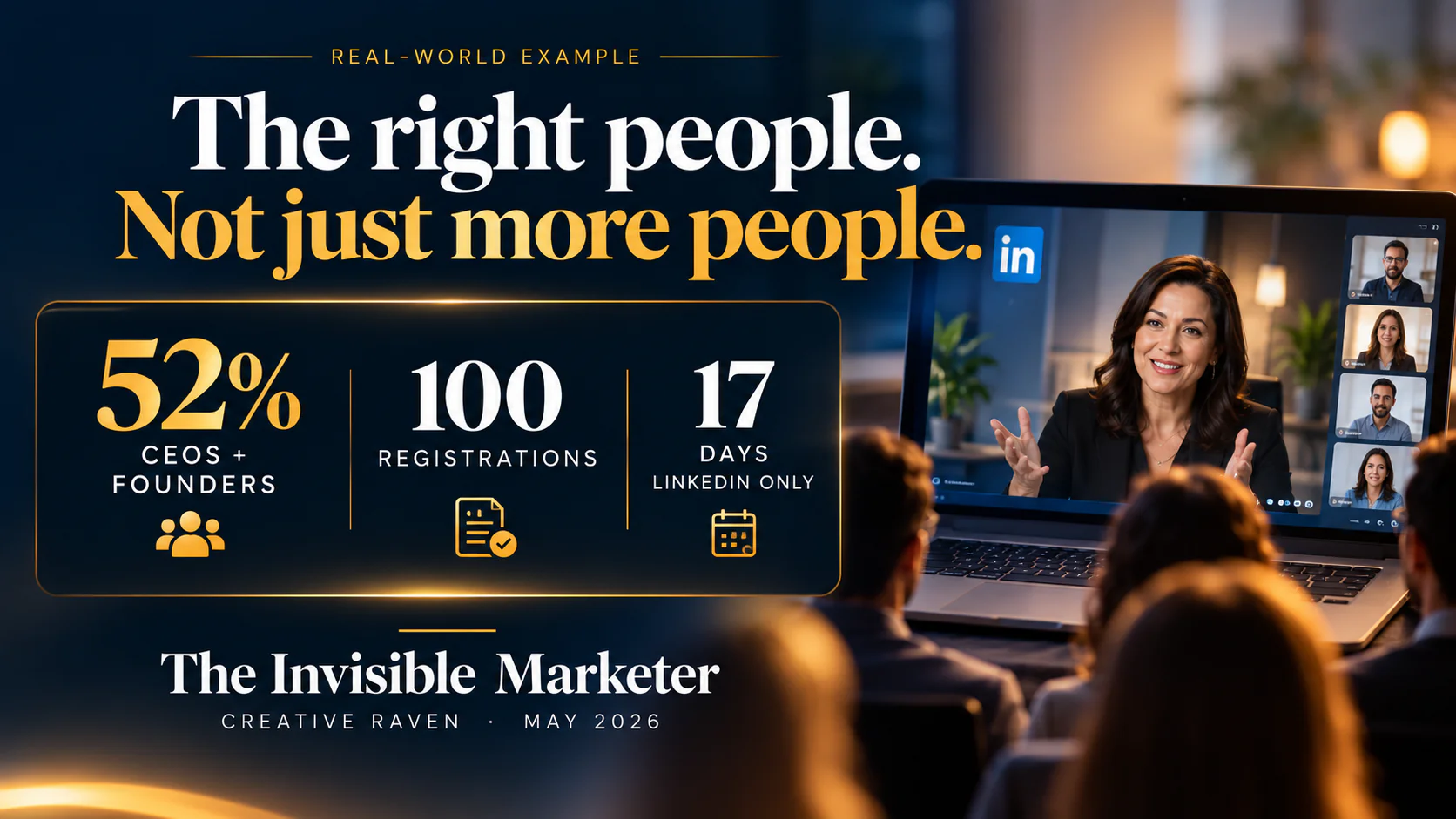
CEOs + FOUNDERS
Decision-makers in the room.
REGISTRATIONS
17-day campaign. LinkedIn only.
CORE SECTOR
Wastewater, water and environmental.
REPLIES
Replies received.
BUYING INTEREST
Showing direct buying interest.
And it didn’t end with one event.
No paid ads. LinkedIn only. A niche B2B industry.
The objective wasn’t simply to fill the room. It was to fill it with people who mattered.
Everything included in Event-to-Pipeline for an invitation audience of up to 750 relevant people from your network.
Everything included in Event-to-Pipeline for an invitation audience of up to 1,500 relevant people from your network.
The right size — and a realistic registration target — are worked out during your Trust Asset Clarity Session based on your network, your buyer and the event you want to create.
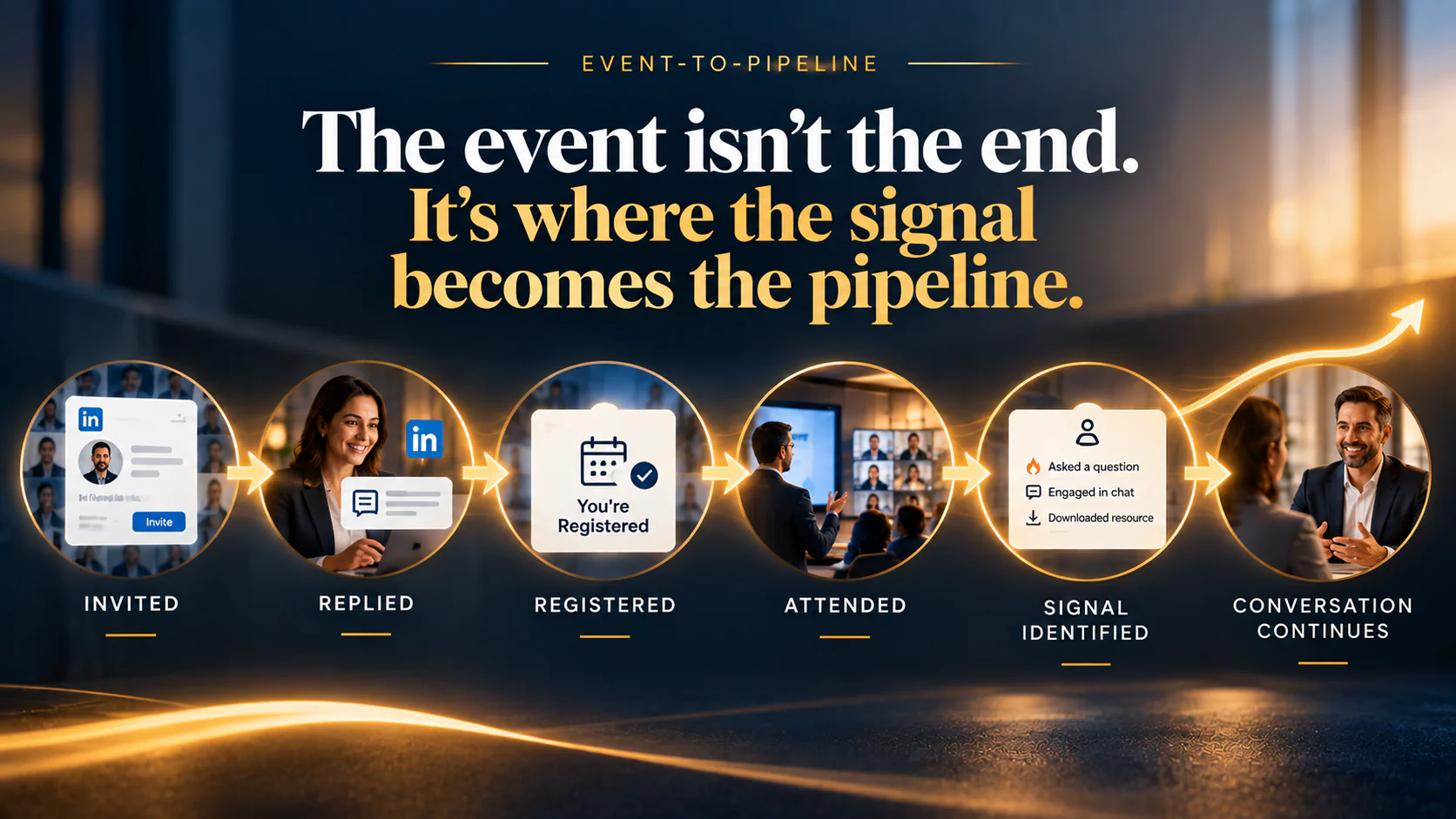
Before the event, we know who was invited.
During the campaign, we know who replied.
After the event, we know who registered, who attended and where genuine interest appeared.
That context matters.
The people who showed up aren’t simply names on an attendee list.
They chose to spend time around a subject connected to your expertise.
They have given you a signal.
As an extension of Event-to-Pipeline, we can keep the right conversations moving for 60 days after the event — while the context is still fresh.
Not by immediately turning the event into a sales pitch.
By using the shared context to continue the conversations that are genuinely worth continuing.
And if those relationships deserve a longer-term system, that’s where Trust First Network takes over.
In high-value B2B, one strong client relationship can be worth far more than the cost of creating the event that started the conversation.
Which is why the important number isn’t simply attendance.
It’s who attended.
A hundred of the right people who chose to spend time with your topic, your expertise and your point of view aren’t merely an audience.
They’re a trust signal.
And some of those signals deserve a conversation.
What you’re really doing is putting the trust you’ve spent years building to work.
Best suited to founders with approximately 3,000+ LinkedIn connections and enough lead time to build the right audience properly.
Not designed for mass-market attendance, B2C events or events less than two weeks away.
Create the reason for the conversation.
Use peer conversations to build relationships before there is a sales need.
Create the reason to show up.
Fill the room with the right people — then keep the worthwhile conversations moving after the event.
Create the reason to believe.
Turn outcomes already achieved into proof the right people can encounter.
We’ll look at your network, your event topic and your buyer together.
Then we’ll map what an Event-to-Pipeline campaign could look like for you — who should be in the room, which campaign size fits and what a realistic registration target looks like.
TRUST ASSET CLARITY SESSION
Every session is followed by a written Trust Asset Evaluation within 48 hours.
The right people. The right room. Conversations worth continuing.