
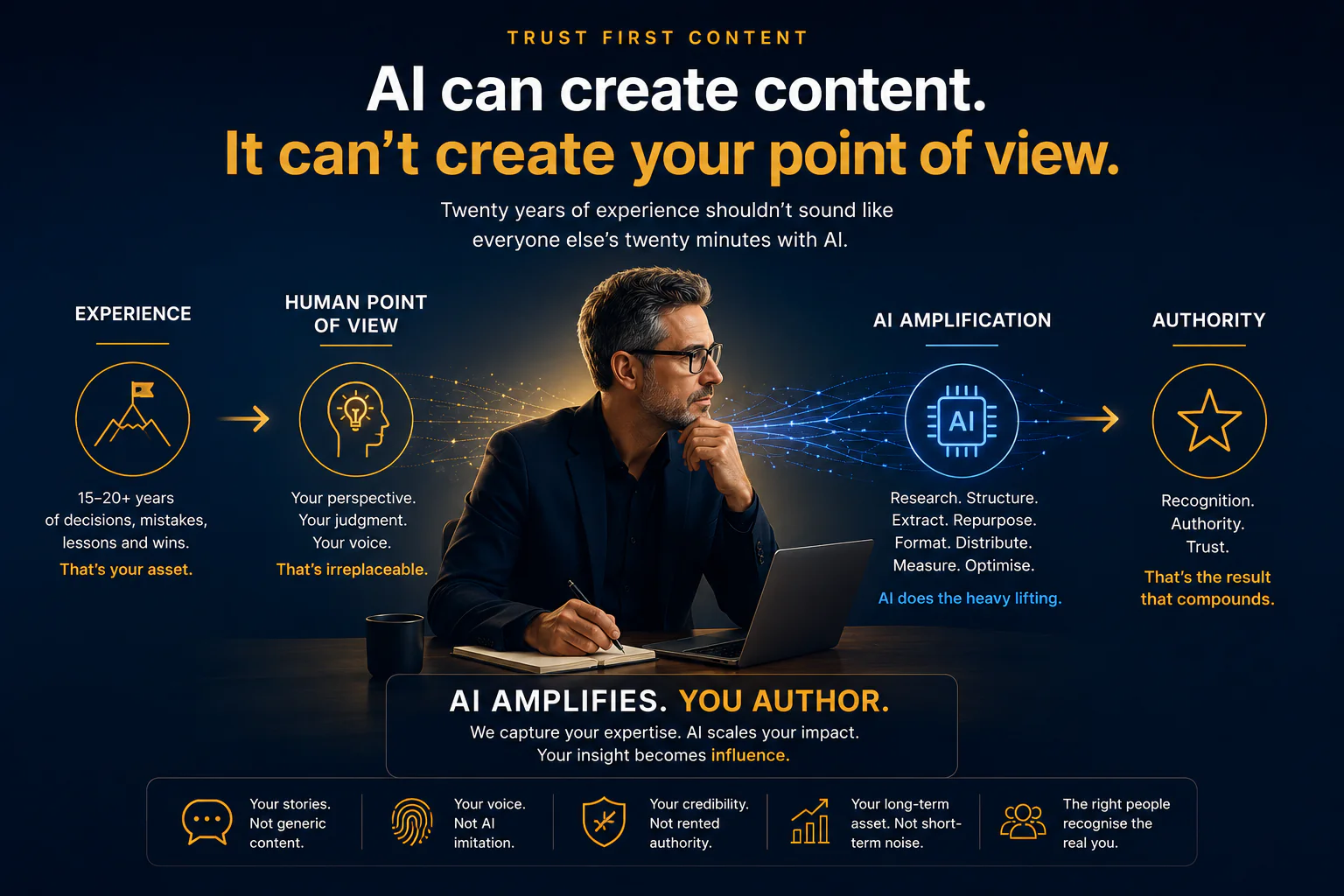
Twenty years of experience shouldn’t sound like everyone else’s twenty minutes with AI.
You’ve spent years making decisions, solving problems, seeing patterns, getting things wrong, getting things right and developing views that only experience can produce.
That is the content asset.
AI has made competent content adundant. Anyone can produce:
Which creates a new problem for experienced founders:
If everyone can create more, what makes you recognisable?
Not volume. Not posting frequency. Not another AI-written version of what everybody in your industry already says.
The advantage is the part AI doesn’t possess:
What you’ve lived. What you’ve noticed. What you believe. What you disagree with. What experience has taught you to see differently.
We aren’t asking AI to decide what you believe. We’re using it to help us uncover, organise and express what you already know. Because there’s a significant difference between:
Content generated about your subject and Content authored from your perspective.
Many experienced founders don’t struggle because they have nothing to say.
They struggle because what they know doesn’t naturally arrive as a LinkedIn post.
It appears in conversation.
Ask the right question and suddenly there’s a story.
A strong opinion.
A client lesson.
An industry frustration.
A decision they’d make differently today.
A pattern they’ve seen twenty times.
That’s why conversation matters.
Instead of beginning with a blank document and asking:
“What should we post this week?”
we can begin with the founder.
Their experiences.
Their decisions.
Their point of view.
Then use AI to help identify the valuable ideas inside the conversation.
You already have a clear point of view. The problem is making it visible consistently.
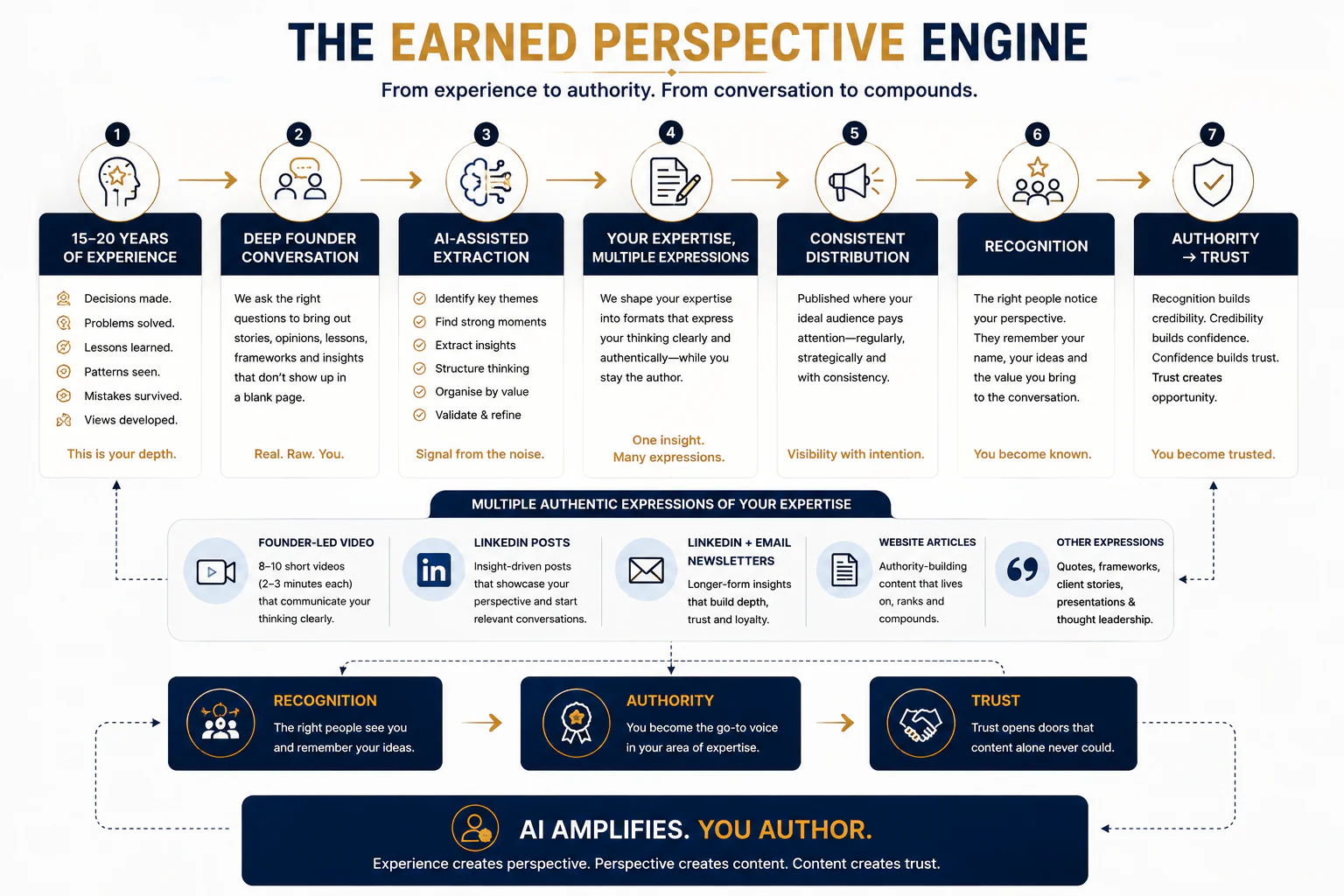
Trust First Founder Content helps turn your thinking, experience, observations and market perspective into an ongoing authority system.
Not content for content’s sake. Content that helps the right people gradually understand: What you know. How you think. What you stand for. Why your perspective is worth following. Best fit when:

Some expertise needs to be drawn out before it can be distributed. We begin with a deep founder/expert conversation of approximately 60 minutes. From that conversation, we identify the strongest insights and shape them into multiple authentic expressions of the founder’s expertise.
Including approximately 8–10 founder-led videos, 2–3 minutes each, plus supporting LinkedIn posts, LinkedIn + email newsletters and website articles. The founder’s face. The founder’s voice. The founder’s thinking. Not mass-produced AI video pretending to be expertise. Best fit when:

Being visible is useful.
Being remembered for the right thing is much more valuable.
The objective of Trust First Content isn’t simply to keep your name appearing in someone’s feed.
It’s to build an association.
When a certain problem comes up…
When an industry conversation changes…
When someone needs a particular kind of expertise…
Your name should come to mind.
That only happens when your content repeatedly connects your perspective with the problems you want to own.
Not repetitively.
Consistently.
What you know
How you think about it
How people experience your thinking
What people know you for
What they trust you for
“I know what I think. I just need a system that turns it into consistent authority.”
“I know there’s a lot in my head, but I need someone to draw it out and turn it into usable content.”
“I know I should be more visible, but I’m not sure what people should know me for.”