
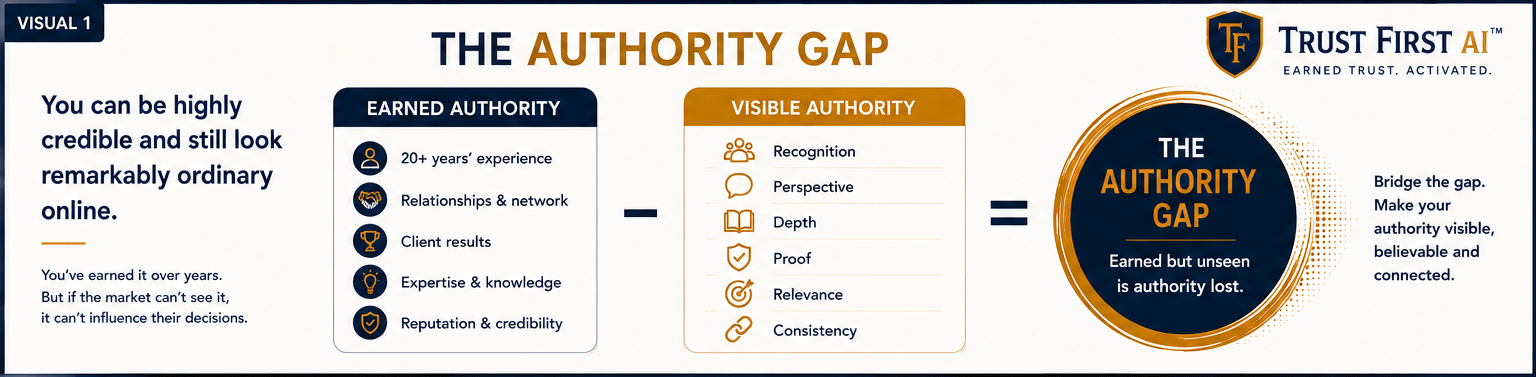
You know what you’ve done. Your clients know what you’ve done. Your closest network probably knows too.
But a prospect encountering you today doesn’t have 20 years of context.
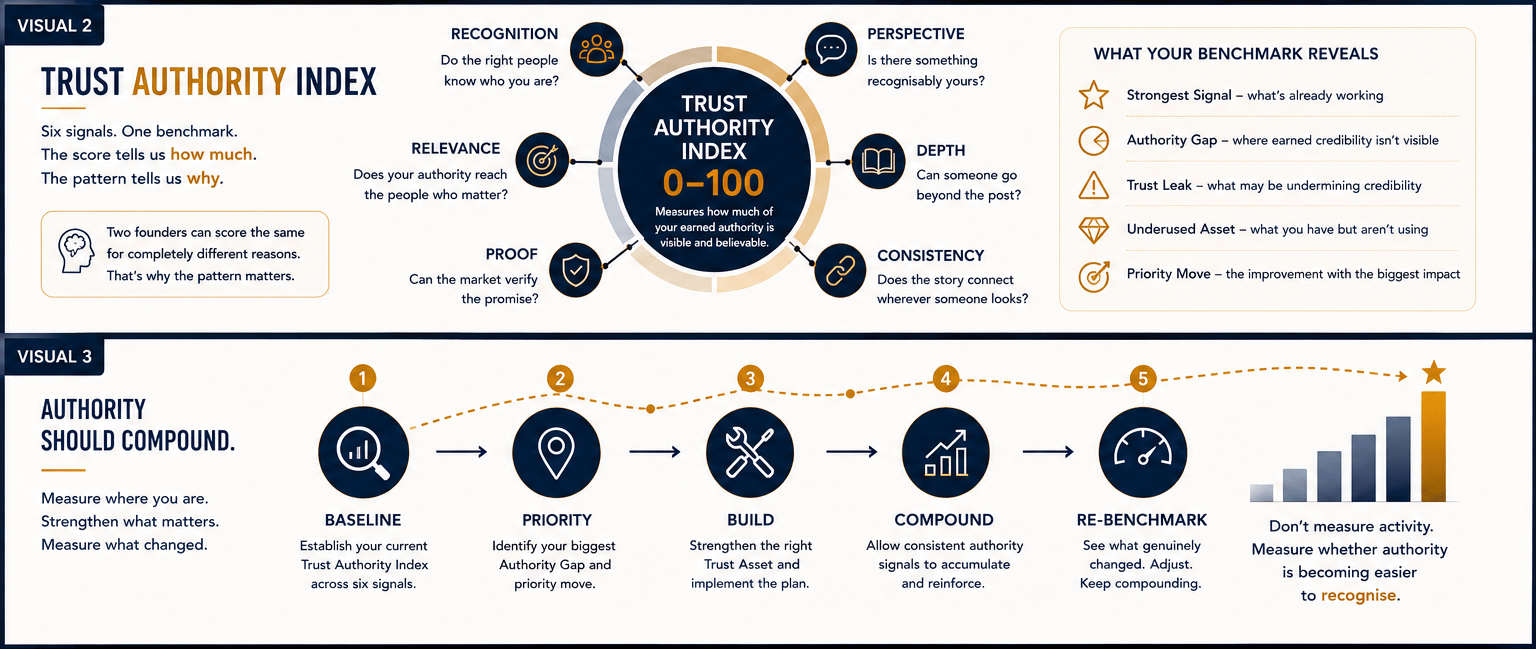
The Trust Authority Benchmark measures how much of the authority you’ve earned is actually visible, believable and connected when someone encounters you.
This is particularly common with experienced B2B founders.
They’ve spent years building companies, solving difficult problems, serving clients, developing expertise, building industry relationships and creating results.
But online?
A generic LinkedIn headline. Occasional posts. A website saying essentially the same thing as competitors. Client proof buried three clicks deep. No recognisable body of thinking. No clear connection between the person, their expertise and the results they’ve created.
The expertise is real. The authority signal isn’t.
It has never been easier to produce a polished post, a thoughtful article, a professional website, a convincing email or a sophisticated-looking point of view.
That is useful. But it creates a new problem. Polish is no longer proof. When almost anyone can sound knowledgeable, buyers need stronger signals to decide who actually is knowledgeable:
Experience. Specificity. Consistency. Client evidence. Recognisable thinking. Relevant relationships. Depth. A history that connects.
AI made expertise easier to imitate. Which makes earned authority more valuable — if people can see it.
Do the right people know who you are? Evidence of relevant visibility and familiarity rather than follower volume.
Is there something recognisably yours? Can someone tell what you believe, how you think and what you’ve learned that an AI summary of your industry couldn’t tell them?
Can someone go beyond the post? Long-form content, podcast conversations, articles, newsletters, video, frameworks and ideas with enough substance to establish expertise.
Can the market verify the promise? Client recommendations, case studies, specific results, stories and credible third-party evidence.
Does your authority reach the people who matter? The right network, industry, roles and conversations — not merely more people.
Does the story connect wherever someone looks? LinkedIn, website, search, content, client proof and positioning.
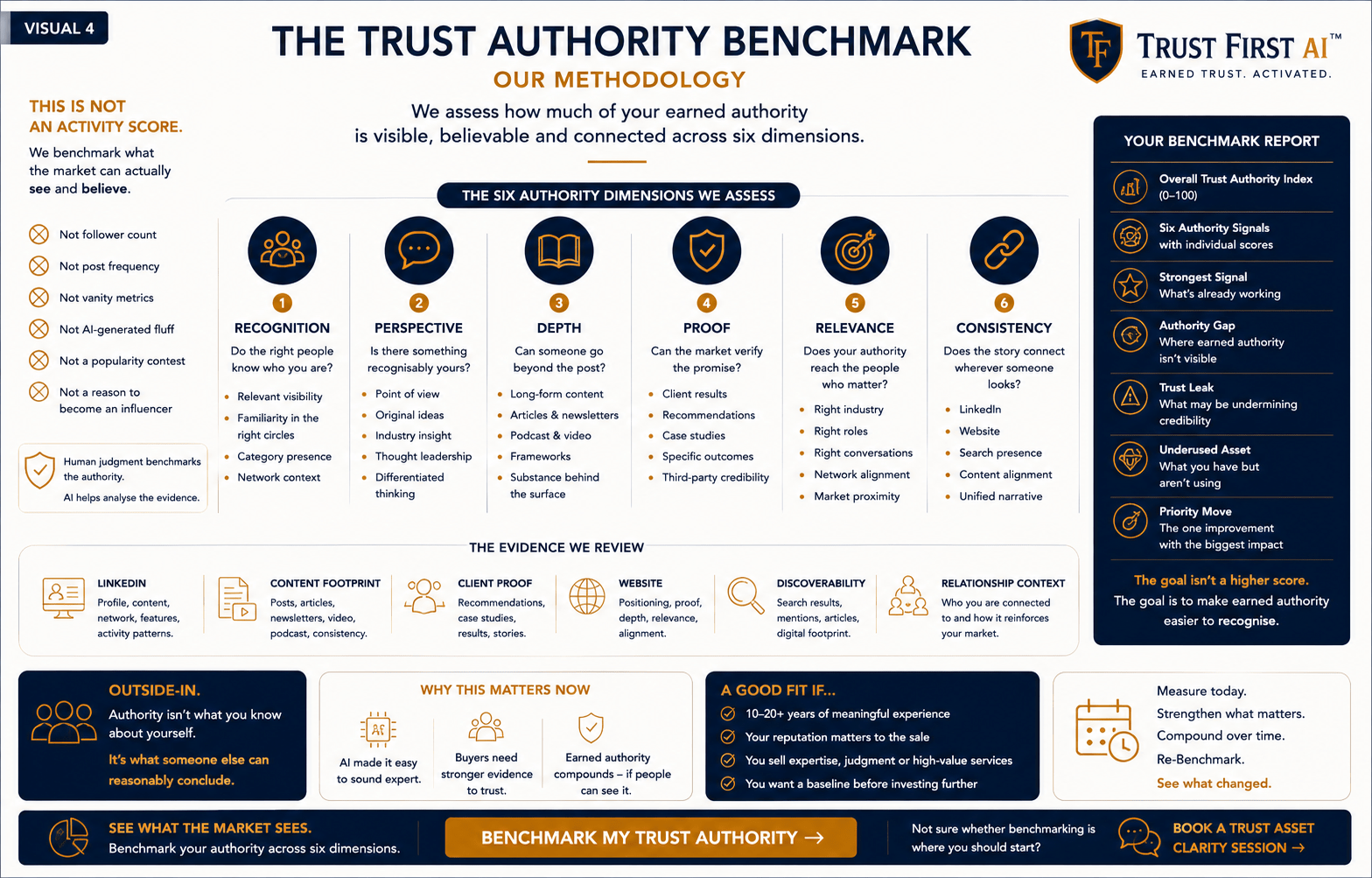
Each of the six authority dimensions receives its own assessment.
They can combine into an overall Trust Authority Index from 0–100 once the scoring methodology is finalised.
But the headline number is not what matters most.
Two founders could both score 68 for completely different reasons. One may have exceptional expertise and proof but almost no visibility.
Another may be highly visible but have weak depth and little credible proof.
Same score. Completely different problem.
The score tells us how much. The pattern tells us why.
Profile positioning · Founder narrative · Featured assets · Recommendations · Visible expertise · Network context
Posts · Articles · Newsletters · Video · Podcast · Long-form authority · Consistency of ideas
Recommendations · Testimonials · Case studies · Results · Specificity · Third-party credibility
Founder visibility · Positioning · Proof · Depth · Consistency with LinkedIn
What someone finds when they look for you · Search presence · Mentions · Articles · Digital footprint
Whether the people around you reinforce the market you claim to serve
We benchmark what a prospective buyer can actually encounter.
You might know you’ve worked in the industry for 22 years, served major companies, solved complex problems, spoken at conferences, built exceptional client relationships or developed a distinctive methodology.
But if a prospect can’t discover that, they can’t use it to make a trust decision.
The Benchmark therefore asks: What evidence does the market actually receive?
Not: What could you tell them if you got an hour in the room?
Your current visible-authority benchmark — once the scoring methodology is finalised.
Recognition · Perspective · Depth · Proof · Relevance · Consistency
What is already helping people trust you.
Where earned credibility isn’t becoming visible authority.
Where inconsistency or weak evidence may be undermining credibility.
Something you’ve already earned but aren’t exploiting properly.
The one improvement most likely to strengthen the authority system first.
The goal isn’t a higher score. The goal is to make earned authority easier to recognise.
What trust have you already earned — and what should move first?
Looks across Connections + Content + Clients to determine where the opportunity sits.
How much of your earned authority can the market actually see and believe?
Measures Recognition + Perspective + Depth + Proof + Relevance + Consistency to identify the Authority Gap.
AI can help us collect information, organise evidence, compare signals, analyse consistency, identify patterns and surface gaps.
But questions such as:
Does this point of view feel earned? Is this proof actually persuasive? Would the right buyer care about this? Does the founder sound like everyone else? Is this impressive — or merely polished?
Require judgment.
AI helps analyse the evidence. Human judgment benchmarks the authority.
This is not:
A follower-count contest. A profile-completeness checker. A social-media engagement report. An AI-generated personality assessment. A leaderboard of who posts most often. A way of telling you that you need to become an influencer.
And it definitely isn’t:
“You scored 63. Buy our package to reach 85.”
The Benchmark exists to show what the market can currently believe.
Establish visible authority today.
Identify the biggest Authority Gap.
Strengthen the relevant Trust Asset/system.
Allow consistent authority signals to accumulate.
See what genuinely changed.
Benchmark your authority across: Recognition. Perspective. Depth. Proof. Relevance. Consistency.
Not sure whether Benchmarking is where you should start?