


That doesn’t mean you damage it.
Becoming commercial can be a natural next step in a professional relationship.
But something does change.
Until that point, two people may simply be exchanging ideas, expertise or perspective. The moment one person introduces something the other could buy, another possibility enters the relationship.
You could become my client.
I could become your vendor.
And that can change how the conversation is understood.
Sometimes the commercial move feels completely natural.
Of course we should talk about this. You might actually be able to help me.
Other times, the same move produces an entirely different reaction.
Ah. So this is why you wanted to talk to me.
The difference isn’t necessarily how long the two people have known each other.
It isn’t even whether somebody is selling.
In both cases, they are.
The more interesting question is:
What was already true in the relationship before the sale entered it?
The same sale can mean two very different things
Someone you barely know asks for a call.
You know what this is.
They’re selling.
Now imagine someone you’ve been talking with hears a problem they understand and says:
We deal with something very similar. Would it help if I showed you how?
They’re selling too.
But it doesn’t feel the same.
The difference isn’t the sale. It’s what happened before it.
In the first situation, the seller decided there was something to sell.
In the second, the conversation revealed there might be something worth buying.
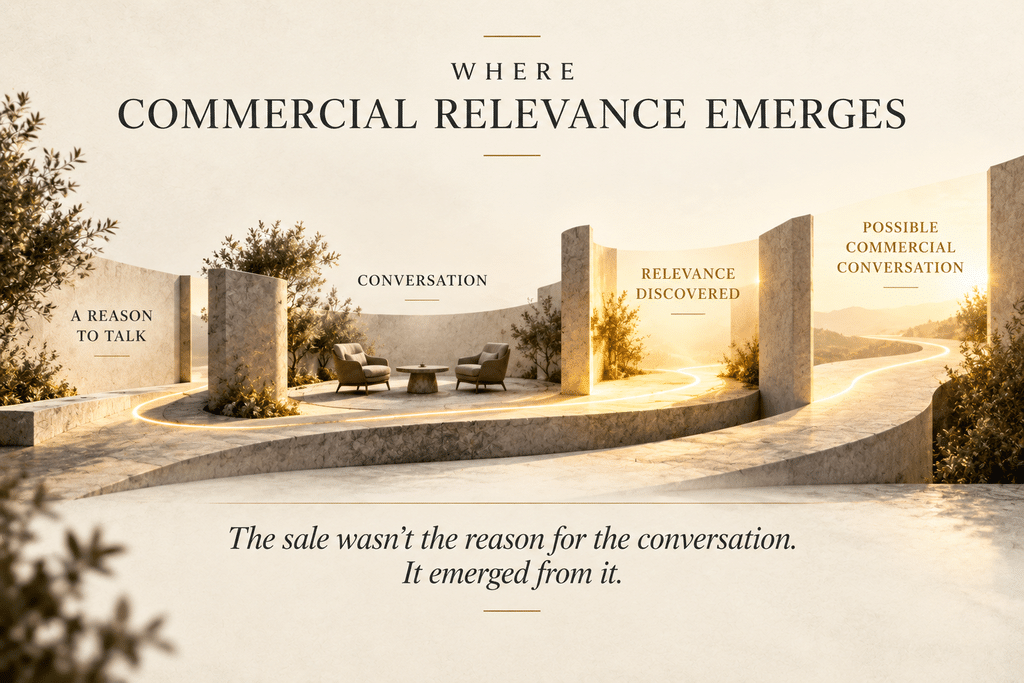
They had a reason to talk before they had a reason to buy
I’ve seen this repeatedly in work with one of my clients.
She has spent more than 25 years in a highly specialized B2B industry. She invites senior people from that industry onto her podcast and offers others opportunities to contribute to industry PR.
They don’t come to discuss her services.
They come because there is already a useful reason to talk.
And then they talk.
They discuss the industry. Their businesses. What is changing. What they are trying to accomplish.
They also experience how well she knows their world.
Not because she told them she is an expert.
Because they have just spent time with her.
Problems surface.
Her expertise becomes relevant.
And sometimes the conversation becomes commercial.
One person entered through a PR conversation and ended up wanting to discuss a much broader marketing engagement.
Another was coming onto the podcast and became interested in a different service that could help him become a stronger thought-leadership voice for his company.
They didn’t enter those conversations looking for those services.
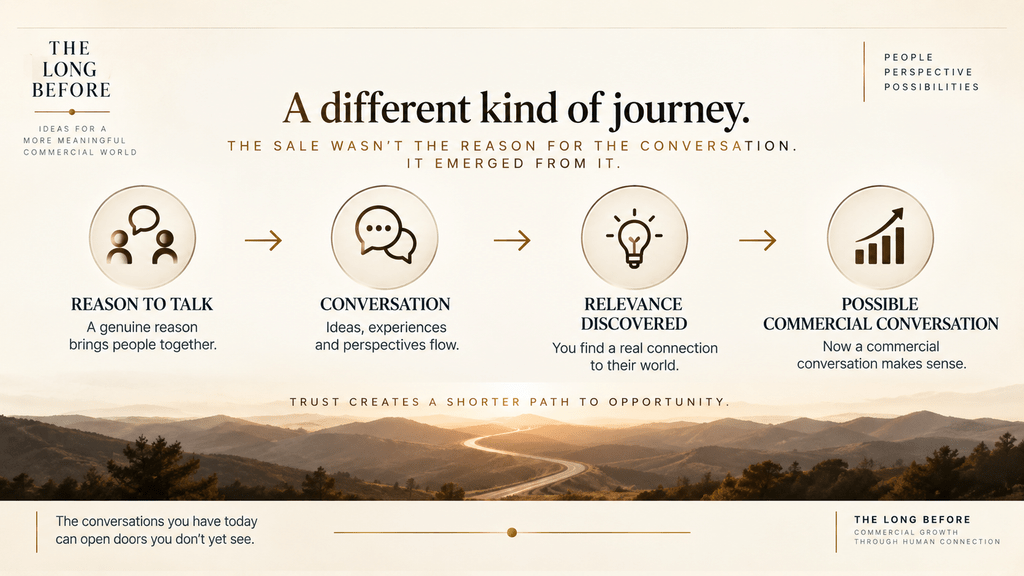
They discovered the relevance inside the conversation.
Now put the service in the first message
They tried that too.
It didn’t work.
When the commercial service itself was put into LinkedIn outreach, my client’s assessment was uncomplicated:
People didn’t bite.
So they stopped making the service the reason to talk.
This doesn’t prove that direct commercial outreach never works.
Of course it does.
And it certainly doesn’t mean everyone should start a podcast.
The interesting part is the contrast.
Same expertise.
Same services.
Same market.
Different point at which the sale entered the relationship.
In one case, relevance was presumed before the conversation began.
In the other, it had a chance to be discovered.
This is where “Give First” can easily go wrong
There is plenty of advice in B2B about giving value before asking for something.
Give.
Give again.
Build trust.
Then make the ask.
But that’s still a sales sequence.
Just a longer one.
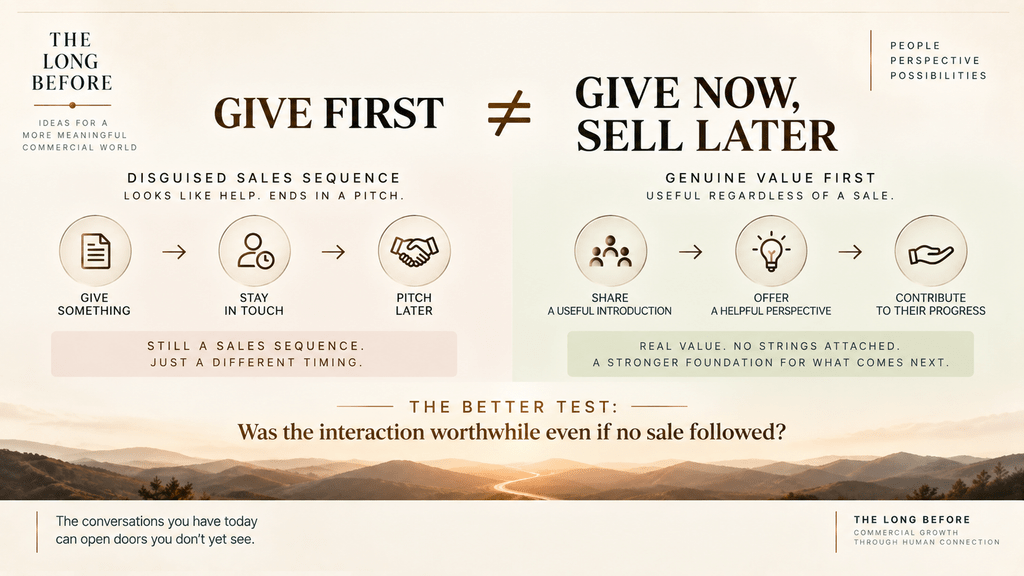
If everything I give you is really an investment I’m making so that I can eventually pitch you, the transaction was there from the beginning.
I just delayed revealing it.
And when the commercial ask finally arrives, it can make you reinterpret everything that came before it.
Ah.
That’s what all this was for.
There is nothing wrong with hoping professional relationships eventually create commercial opportunities.
Businesses need customers.
People need to sell.
The better test may be simpler:
Was the interaction worthwhile even if no sale followed?
A useful introduction can still be useful.
A podcast invitation can still create visibility.
An industry contribution can still be worth making.
A good professional conversation can still be a good professional conversation.
Business may emerge from any of them.
But business wasn’t the hidden price of the interaction.
The commercial conversation still has to happen
There is another mistake we could make here.
We could become so afraid of damaging trust that we never introduce commercial intent at all.
That doesn’t make much sense either.
Sometimes somebody tells you exactly what they are struggling with.
You understand the problem.
You have relevant experience.
You may genuinely be able to help.
At that point, refusing to mention it isn’t necessarily more generous.
It may simply be unhelpful.
One conversation from my client’s work captures this particularly well.
A senior industry contact was explaining that his company had always been known for one thing, but he wanted to know how to tell a broader story about what the business could now do.
My client listened.
Then she essentially asked:
Would you like some help with that?
He said yes.
And the conversation moved forward.
The problem had appeared.
The expertise was relevant.
The commercial conversation made sense.
The sale became a continuation of the conversation rather than an interruption of it.
Perhaps that is the permission we are looking for
We often talk about “earning the right to sell.”
I’m not sure that is quite the right way to think about it.
It can make trust sound like a balance we accumulate until we have deposited enough value to withdraw a sales conversation.
Maybe the better question isn’t:
Have I earned the right to sell to this person?
Maybe it is:
Has this interaction revealed something worth selling into?
That could happen after several years.
Or during the first serious conversation you ever have.
Time isn’t necessarily what creates permission.
There is no fixed number of interactions after which selling suddenly becomes appropriate.
But there is a meaningful difference between introducing a solution because you want to sell it and introducing one because the conversation has made its relevance visible.
The relationship will change

The moment a professional relationship becomes commercial, something does change.
Roles become clearer.
Expectations change.
Money enters the picture.
That is unavoidable.
And perhaps it shouldn’t be avoided.
The question is what existed before that moment.
Were you still trying to establish why this person should care?
Or had the interaction already revealed a reason?
The strongest commercial conversations I’ve seen don’t always begin because someone found the perfect moment to make an ask.
Sometimes they begin because two people had a good enough reason to talk before they had a reason to buy.
They talked.
They understood each other a little better.
A problem became visible.
Expertise became relevant.
And the possibility of working together emerged from what they discovered.
Perhaps that is what we should be looking for before we introduce the sale.
Not whether enough time has passed.
Not whether we’ve given enough value.
Not whether we’ve earned enough relationship credit to finally make the ask.
Something simpler:
Do we both understand why this conversation should now become commercial?
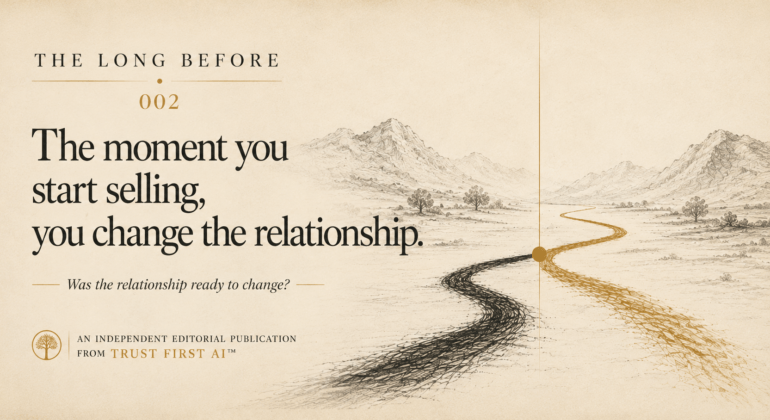
Because the moment you start selling, you do change the relationship.
That is the long before.
The Long Before looks at what was already happening before the visible commercial moment: the conversations, experiences, relationships and accumulated trust that made what happened next possible.
What have you experienced?
There is another side to this question that cannot be answered from one perspective alone.
Think about the last time a useful professional conversation turned into a sales conversation.
What made the commercial move feel natural, or made you suddenly feel you were being sold to?
I am exploring that question with readers as part of Issue 002.
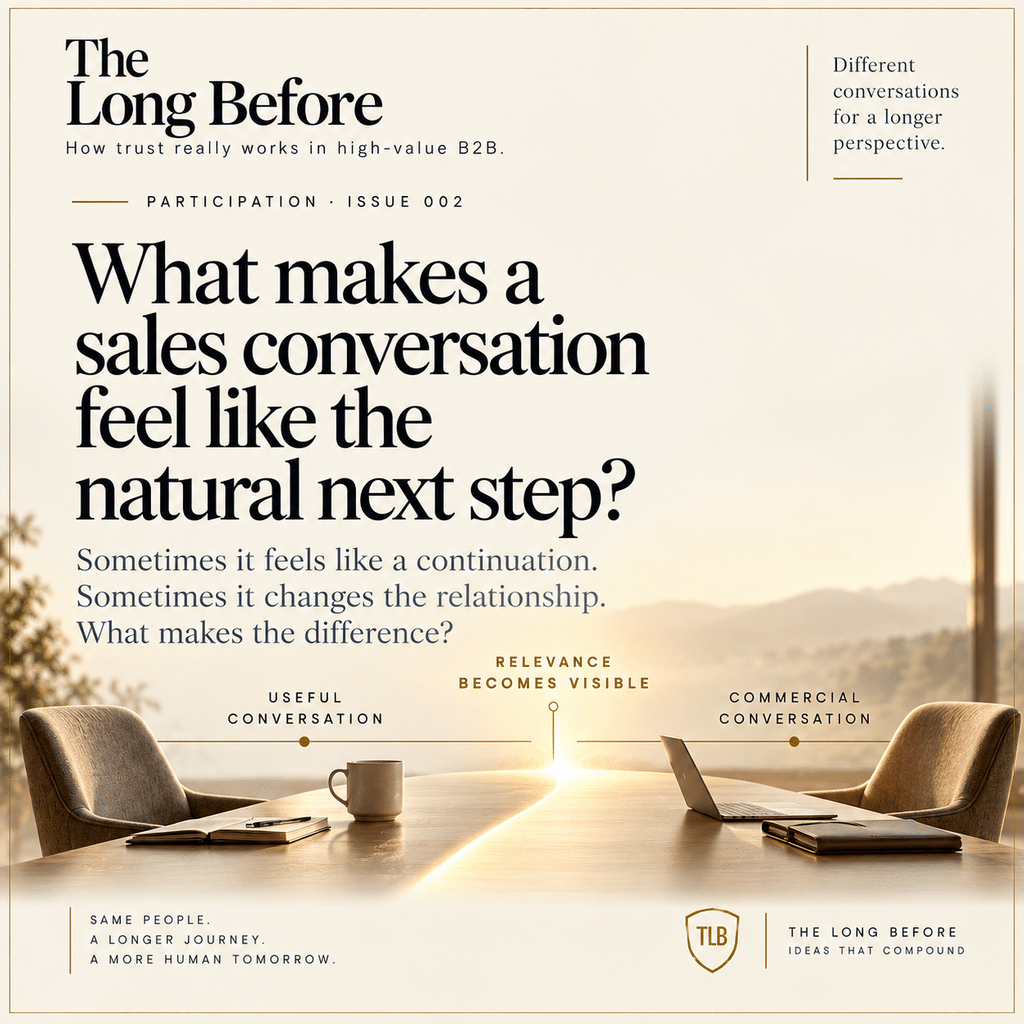
Join the conversation and vote in the live LinkedIn poll → https://lnkd.in/p/gzWYQY2U
The question is whether the relationship was ready to change.