



The proposal is signed.
The kickoff happened months ago.
The client already chose you.
Then, one afternoon, you realise something isn’t going to plan.
Perhaps a deadline is going to slip. A result isn’t what you expected. Someone on your team has made a mistake. Or you’ve discovered that the approach everyone agreed to isn’t going to solve the problem you thought it would.
The client doesn’t know yet.
You do.
And in the next few hours, they may learn something about you that they couldn’t have learned before they hired you.
Not from the proposal. Not from your recommendations. Not from the conversations that won the work.
They are about to see what you’re like when the work gets uncomfortable.
Before they hired you, they had reasons to trust you
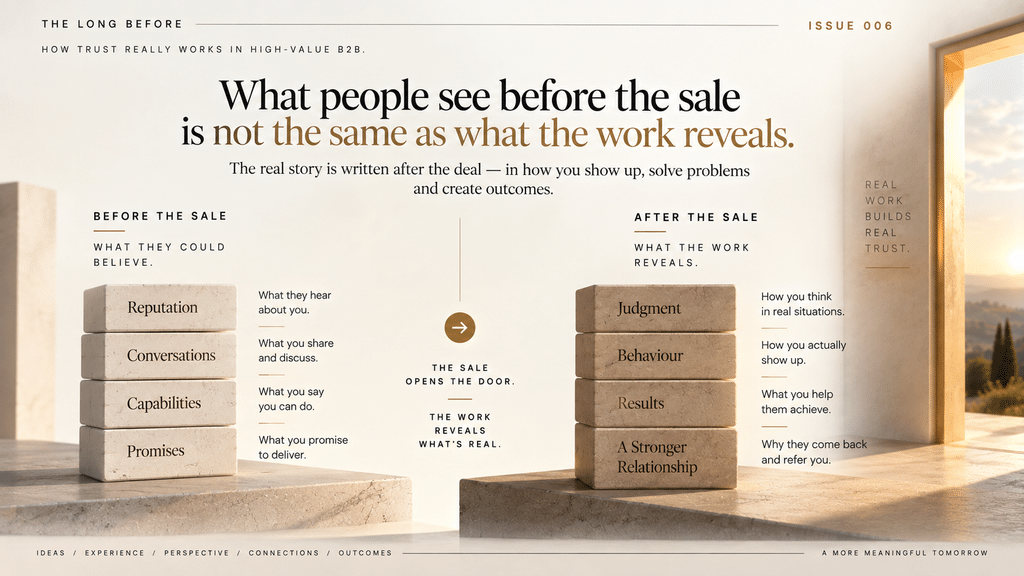
Nobody hires an experienced agency or consultancy with nothing to go on.
There was probably something there already.
A recommendation. A previous conversation. Work they had seen. Someone they trusted who knew you. Years of published thinking.
Then came the meetings. The questions. The proposal.
By the time they said yes, they had accumulated reasons to believe you could do what you said you could do.
But there was something they couldn’t fully know yet.
What would it actually be like to trust you with their business?
For that, they had to become a client.
After yes, the evidence changes
Before the work, much of what the buyer can judge is evidence about you.
What other people say. What you’ve done before. How you think. How well you understand their problem. How you behave while trying to win the work.
Once the work begins, they get something different.
Their own experience of you.
They see whether the thinking survives contact with their actual business.
Whether you understand more after six months than you did in week one.
Whether the senior person who impressed them during the sale is still present once the retainer starts.
Whether the check-in calls are useful or simply happen because they’re on the calendar.
Whether the due diligence is as careful as you said it would be.
Whether you keep bringing judgment after the pitch is over.
And whether the results resemble what both of you believed the work could produce.
This is where something said before the sale meets something that can only be experienced after it.
The client gets to compare what they were given reason to expect with what it is actually like to work with you.
That doesn’t mean everything will happen exactly as planned.
The client’s business will change. New information will appear. Assumptions will prove wrong. Sometimes the right thing to do six months into an engagement will be different from what everyone agreed at the beginning.
The question isn’t whether everything stayed the same.
It’s whether the client can still recognise the judgment, care, expertise and way of working that gave them confidence in the first place.
Most of the evidence arrives on ordinary days
Not every client relationship has a dramatic test.
Much of what the client learns happens during ordinary work.
The thing you remembered from three months ago.
The recommendation that makes your own job harder but is better for them.
The meeting where you say, “I don’t think we should do that,” when agreeing would be easier.
The piece of work nobody has to chase.
The question you ask because you’ve begun to understand their business rather than merely the service you’re providing.
None of these moments announces itself as a trust-building exercise.
They’re just the work.
But over time, claims can become experience.
They do what they say.
They understand us.
They’ll tell me when they disagree.
I don’t have to chase them.
If something isn’t right, they’ll tell me.
Those are things the client couldn’t have known when they signed the proposal.
Then something goes wrong
Which brings us back to that afternoon.
You know something the client doesn’t.
There is a temptation to think only about fixing the problem.
Can we sort it out before they notice? How serious is it? Whose fault was it? What do we tell them?
But the problem is also creating evidence.
Do you tell them early?
Do you spend the first five minutes explaining why it wasn’t really your fault?
Do you know what you’re going to do next?
Do you keep following the agreed process because that’s what was promised, even though your judgment now tells you it isn’t going to work?
Or do you have the harder conversation?
A difficult moment doesn’t automatically build trust.
Poor work doesn’t become good work because you were admirably candid about it. And repeatedly handling the same problem well is not the same as fixing the reason it keeps happening.
But difficulty can reveal something the sales process couldn’t.
The client gets to see what happens when protecting your reputation and telling them what they need to know are no longer exactly the same thing.
AI can hold the context. Judgment is still yours.
Long client relationships accumulate more context than any of us can reliably hold.
Calls. Decisions. Commitments. Results. Changes in direction. Things someone promised to revisit three months ago.
Used intelligently, AI can help retain that context, surface commitments, monitor progress, spot drift and remove repetitive work that gets in the way of delivery.
It can help you remember what was promised and notice when what is happening no longer resembles it.
But that isn’t the same as judgment.
AI can tell you what was agreed six months ago. It can’t decide whether keeping that agreement or challenging it is now the more responsible thing to do.
AI can help hold the context. Human judgment still has to decide what the context means.
And that judgment has a useful reference point:
What did we give this client reason to expect?
What are they experiencing now?
And if those two things are drifting apart, what needs to happen next?
The next decision may already be forming
We often talk about trust as something required to win the work.
Then the client signs. Delivery begins. Acquisition starts looking for the next client.
But the client’s judgment hasn’t stopped.
They now have something the prospective buyer didn’t have:
first-hand evidence.
So perhaps the useful question isn’t:
How do we build more trust with this client?
It is:
What is this client learning about us from the way we are working together?
Because somewhere ahead, another decision may appear.
A renewal. Another piece of work. A recommendation. A former client arriving somewhere new and calling again.
From the outside, these look like new commercial events.
But from the client’s side, they have a history.
The renewal didn’t begin when the renewal meeting was booked. The introduction didn’t begin when somebody asked for a name. The new conversation didn’t begin when your phone rang.
Some of the evidence behind those decisions may have been accumulating while nobody was thinking about another sale.
Good delivery guarantees none of them.
But when another commercial moment arrives, the client isn’t starting only with your promises.
They know what happened when they trusted you the first time.
And now, here is the long before.
A client called you about something new today.
But their judgment didn’t begin today.
Some of it may have formed in the ordinary months when what you promised and what they experienced quietly held together.
Some may have formed when they saw your judgment inside their business.
And some may have formed on the difficult day when things didn’t go to plan and they saw what you did next.
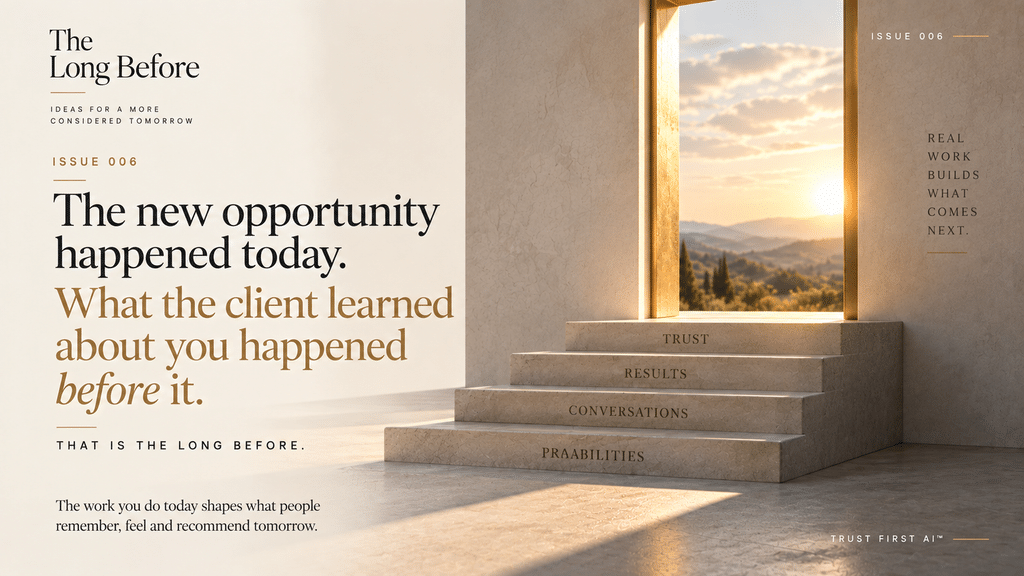
The new opportunity happened today.
What the client learned about you happened before it.
That is the long before.
Participation Poll
WHAT HAVE YOU EXPERIENCED?
Issue 006 asks what a client can learn about you only after they have hired you.
Before yes, they can have reasons to trust you. After yes, they gain something different: their own experience of your delivery, judgment, candour, follow-through and behaviour when the work becomes difficult.
The article argues that the client’s trust judgment does not stop when the proposal is signed. The evidence changes.
But that is an editorial argument.
I would like to compare it with what experienced founders and clients have actually seen.
Think about a client relationship that lasted long enough for the client to really know what it was like to work with you.
What most shaped trust after the sale?

Join the conversation and vote in the live LinkedIn poll: https://lnkd.in/p/gSUy3gpD