

The moment you start selling, you change the relationship. The Long Before – 002

That doesn’t mean you damage it.

Becoming commercial can be a natural next step in a professional relationship.

But something does change.

Until that point, two people may simply be exchanging ideas, expertise or perspective. The moment one person introduces something the other could buy, another possibility enters the relationship.

You could become my client.

I could become your vendor.

And that can change how the conversation is understood.

Sometimes the commercial move feels completely natural.

Of course we should talk about this. You might actually be able to help me.

Other times, the same move produces an entirely different reaction.

Ah. So this is why you wanted to talk to me.

The difference isn’t necessarily how long the two people have known each other.

It isn’t even whether somebody is selling.

In both cases, they are.

The more interesting question is:

What was already true in the relationship before the sale entered it?
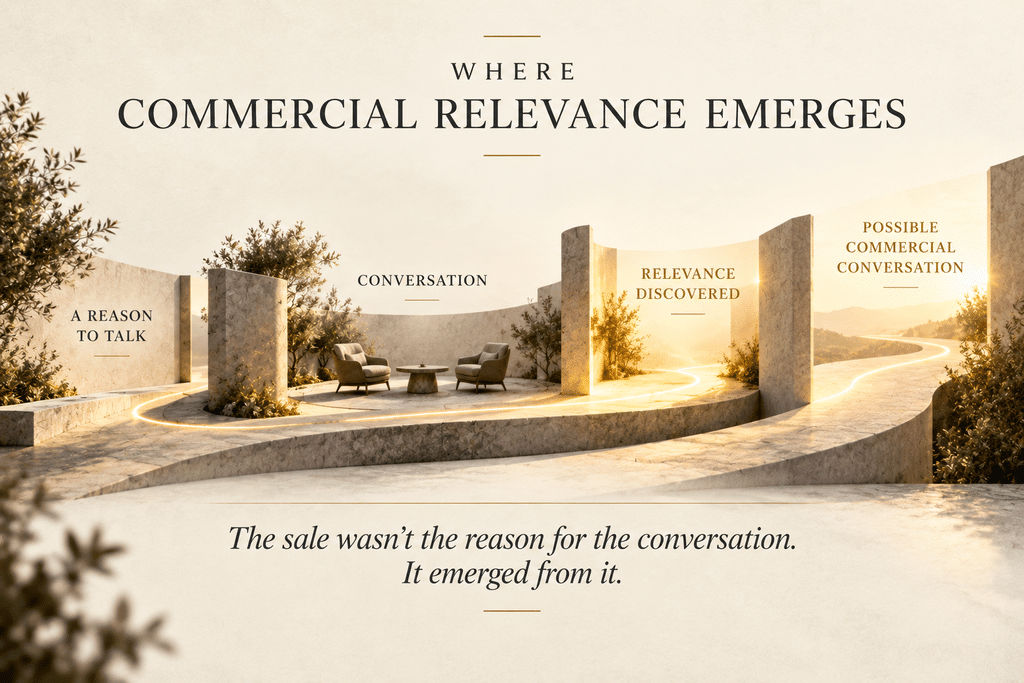
The same sale can mean two very different things

Someone you barely know asks for a call.

You know what this is.

They’re selling.

Now imagine someone you’ve been talking with hears a problem they understand and says:

We deal with something very similar. Would it help if I showed you how?

They’re selling too.

But it doesn’t feel the same.

The difference isn’t the sale. It’s what happened before it.

 In the first situation, the seller decided there was something to sell.

In the second, the conversation revealed there might be something worth buying.

They had a reason to talk before they had a reason to buy

I’ve seen this repeatedly in work with one of my clients.

She has spent more than 25 years in a highly specialized B2B industry. She invites senior people from that industry onto her podcast and offers others opportunities to contribute to industry PR.

They don’t come to discuss her services.

They come because there is already a useful reason to talk.

And then they talk.

They discuss the industry. Their businesses. What is changing. What they are trying to accomplish.

They also experience how well she knows their world.

Not because she told them she is an expert.

Because they have just spent time with her.

Problems surface.

Her expertise becomes relevant.

And sometimes the conversation becomes commercial.

One person entered through a PR conversation and ended up wanting to discuss a much broader marketing engagement.

Another was coming onto the podcast and became interested in a different service that could help him become a stronger thought-leadership voice for his company.

They didn’t enter those conversations looking for those services.
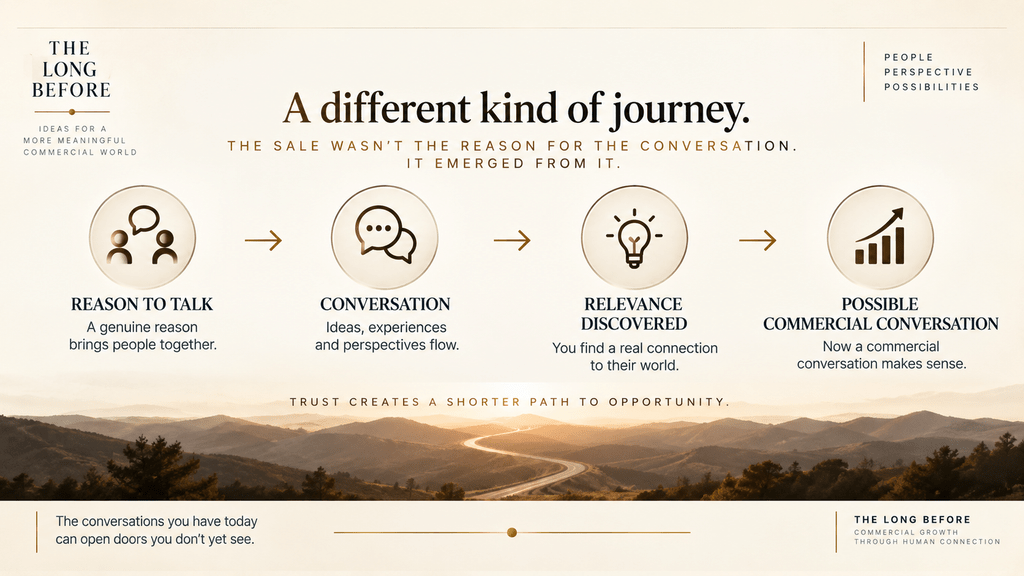
They discovered the relevance inside the conversation.

 Now put the service in the first message

They tried that too.

It didn’t work.

When the commercial service itself was put into LinkedIn outreach, my client’s assessment was uncomplicated:

People didn’t bite.

So they stopped making the service the reason to talk.

This doesn’t prove that direct commercial outreach never works.

Of course it does.

And it certainly doesn’t mean everyone should start a podcast.

The interesting part is the contrast.

Same expertise.

Same services.

Same market.

Different point at which the sale entered the relationship.

 In one case, relevance was presumed before the conversation began.

In the other, it had a chance to be discovered.

This is where “Give First” can easily go wrong

There is plenty of advice in B2B about giving value before asking for something.

Give.

Give again.

Build trust.

Then make the ask.

But that’s still a sales sequence.

Just a longer one.
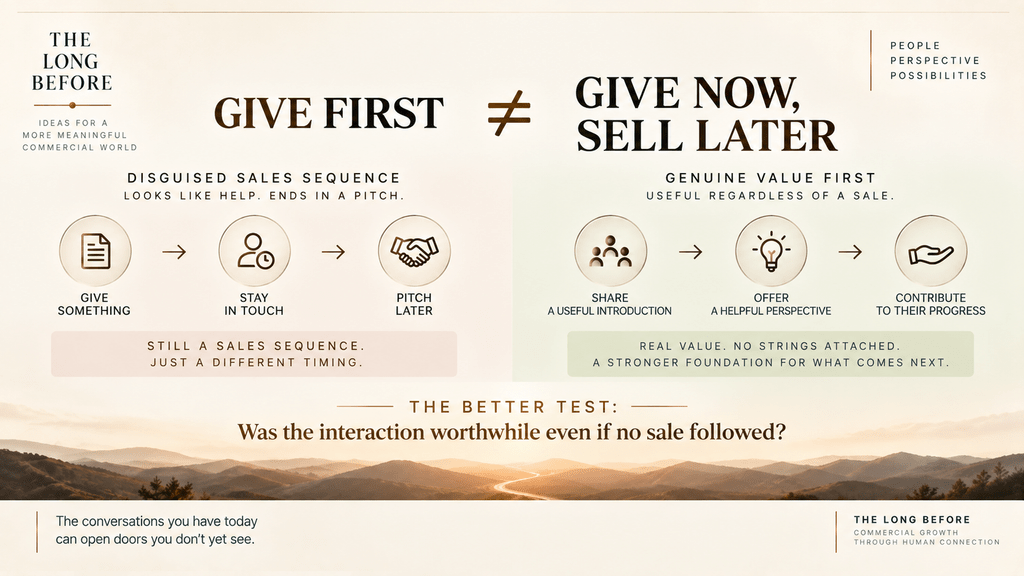
If everything I give you is really an investment I’m making so that I can eventually pitch you, the transaction was there from the beginning.

I just delayed revealing it.

And when the commercial ask finally arrives, it can make you reinterpret everything that came before it.

Ah.

That’s what all this was for.

There is nothing wrong with hoping professional relationships eventually create commercial opportunities.

Businesses need customers.

People need to sell.

The better test may be simpler:

Was the interaction worthwhile even if no sale followed?

 A useful introduction can still be useful.

A podcast invitation can still create visibility.

An industry contribution can still be worth making.

A good professional conversation can still be a good professional conversation.

Business may emerge from any of them.

But business wasn’t the hidden price of the interaction.

The commercial conversation still has to happen

There is another mistake we could make here.

We could become so afraid of damaging trust that we never introduce commercial intent at all.

That doesn’t make much sense either.

Sometimes somebody tells you exactly what they are struggling with.

You understand the problem.

You have relevant experience.

You may genuinely be able to help.

At that point, refusing to mention it isn’t necessarily more generous.

It may simply be unhelpful.

One conversation from my client’s work captures this particularly well.

A senior industry contact was explaining that his company had always been known for one thing, but he wanted to know how to tell a broader story about what the business could now do.

My client listened.

Then she essentially asked:

Would you like some help with that?

He said yes.

And the conversation moved forward.

The problem had appeared.

The expertise was relevant.

The commercial conversation made sense.

The sale became a continuation of the conversation rather than an interruption of it.

 Perhaps that is the permission we are looking for

We often talk about “earning the right to sell.”

I’m not sure that is quite the right way to think about it.

It can make trust sound like a balance we accumulate until we have deposited enough value to withdraw a sales conversation.

Maybe the better question isn’t:

Have I earned the right to sell to this person?

Maybe it is:

Has this interaction revealed something worth selling into?

 That could happen after several years.

Or during the first serious conversation you ever have.

Time isn’t necessarily what creates permission.

There is no fixed number of interactions after which selling suddenly becomes appropriate.

But there is a meaningful difference between introducing a solution because you want to sell it and introducing one because the conversation has made its relevance visible.

The relationship will change

The moment a professional relationship becomes commercial, something does change.

Roles become clearer.

Expectations change.

Money enters the picture.

That is unavoidable.

And perhaps it shouldn’t be avoided.

The question is what existed before that moment.

Were you still trying to establish why this person should care?

Or had the interaction already revealed a reason?

The strongest commercial conversations I’ve seen don’t always begin because someone found the perfect moment to make an ask.

Sometimes they begin because two people had a good enough reason to talk before they had a reason to buy.

They talked.

They understood each other a little better.

A problem became visible.

Expertise became relevant.

And the possibility of working together emerged from what they discovered.

Perhaps that is what we should be looking for before we introduce the sale.

Not whether enough time has passed.

Not whether we’ve given enough value.

Not whether we’ve earned enough relationship credit to finally make the ask.

Something simpler:

Do we both understand why this conversation should now become commercial?

 Because the moment you start selling, you do change the relationship.

That is the long before.

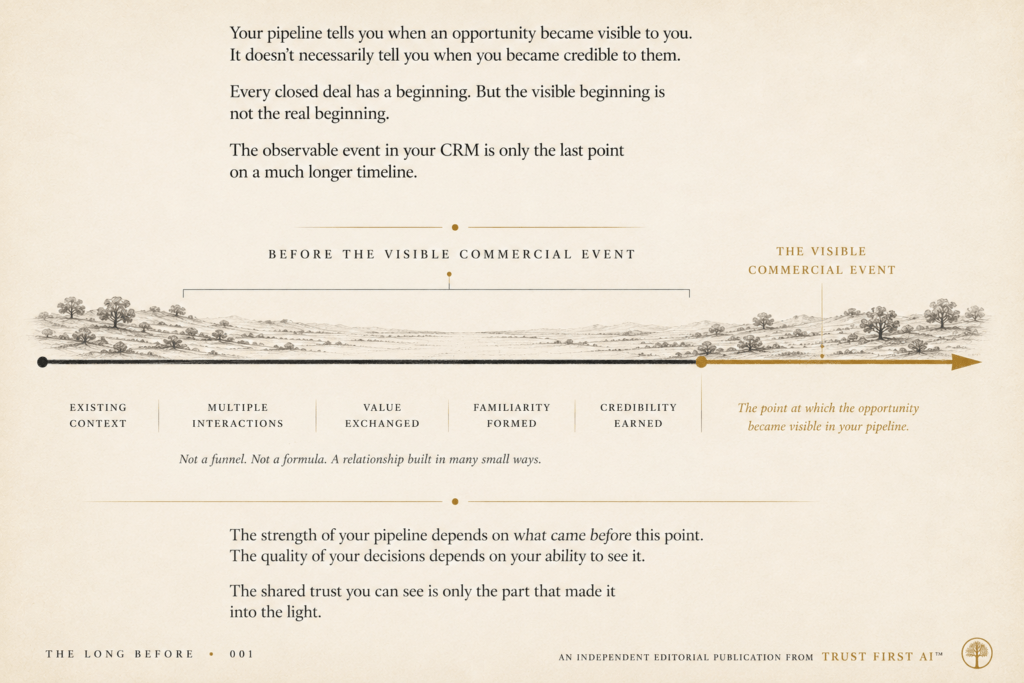
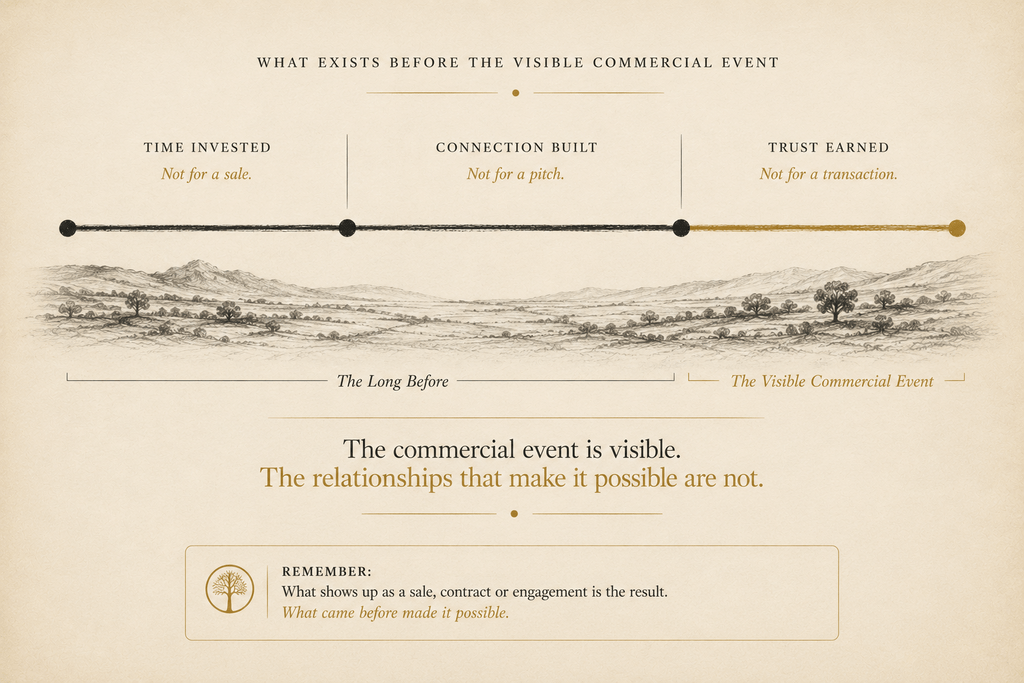
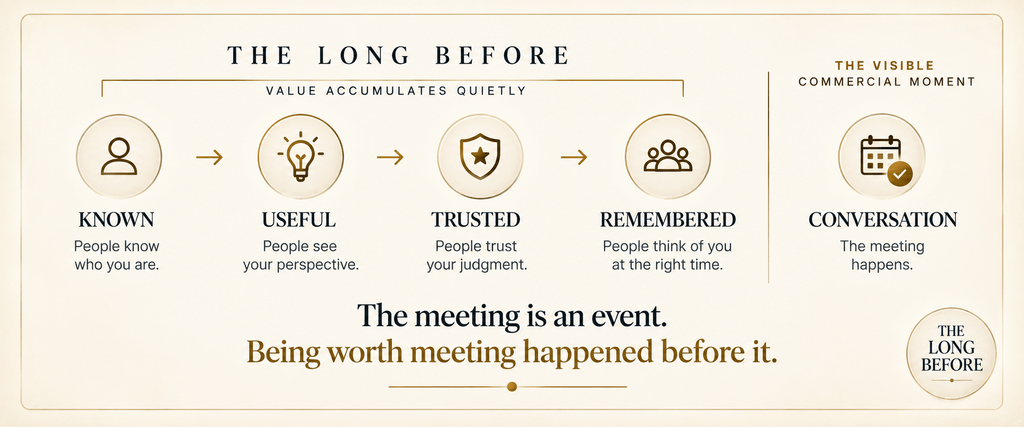
The Long Before looks at what was already happening before the visible commercial moment: the conversations, experiences, relationships and accumulated trust that made what happened next possible.

What have you experienced?

There is another side to this question that cannot be answered from one perspective alone.

Think about the last time a useful professional conversation turned into a sales conversation.

What made the commercial move feel natural, or made you suddenly feel you were being sold to?

I am exploring that question with readers as part of Issue 002.

Join the conversation and vote in the live LinkedIn poll → https://lnkd.in/p/gzWYQY2U

The question is whether the relationship was ready to change.
Read More

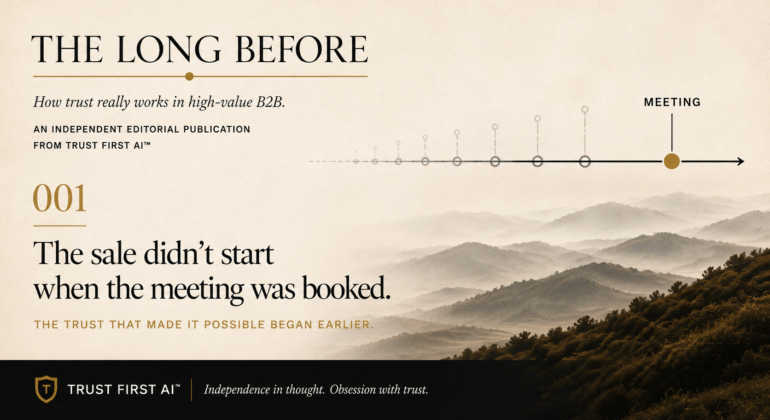
The Sale didn’t Start when the Meeting was Booked. The Long Before – 001

THE LONG BEFORE

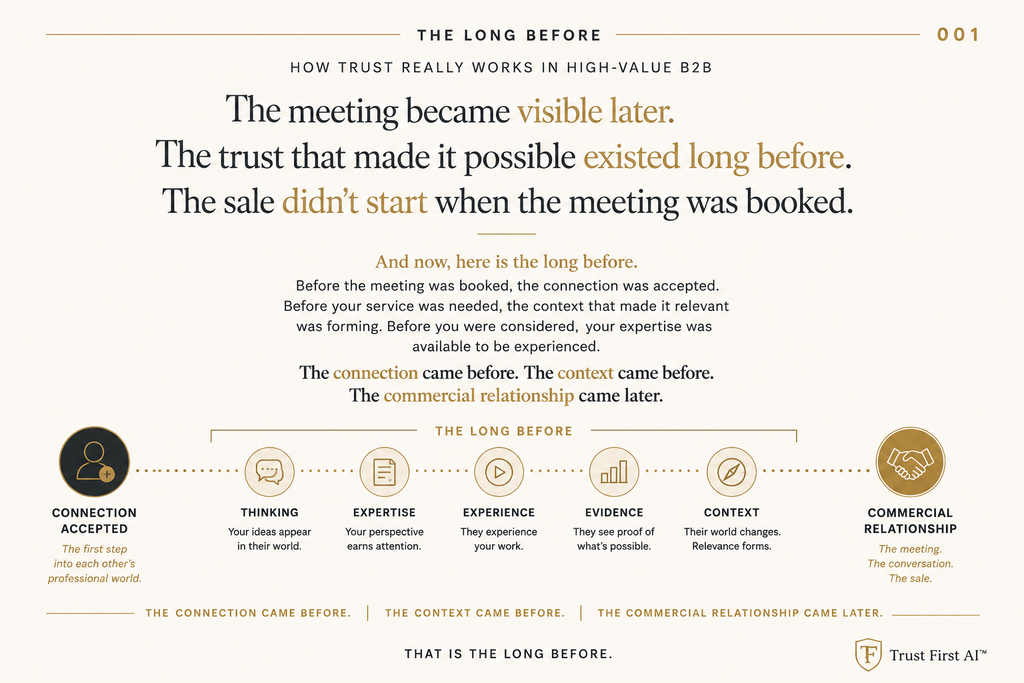
How trust really works in high-value B2B. There is a part of B2B that most of our systems begin measuring too late. Before the opportunity. Before the meeting. Sometimes long before anybody is actively buying.

Relationships, reputation, proof, familiarity — things said, seen or done when there was no immediate commercial opportunity — can suddenly matter when the right problem appears.

That is where I want to begin The Long Before.

A meeting appears in the calendar.

Someone has responded to an introduction. An old connection has come back into view. A prospect has clicked, replied or asked to talk.

Inside the business, this looks like a beginning.

There is now a lead. A source. Perhaps an opportunity in the CRM.

Tuesday, 10:30 a.m.

That is when the system says it started.

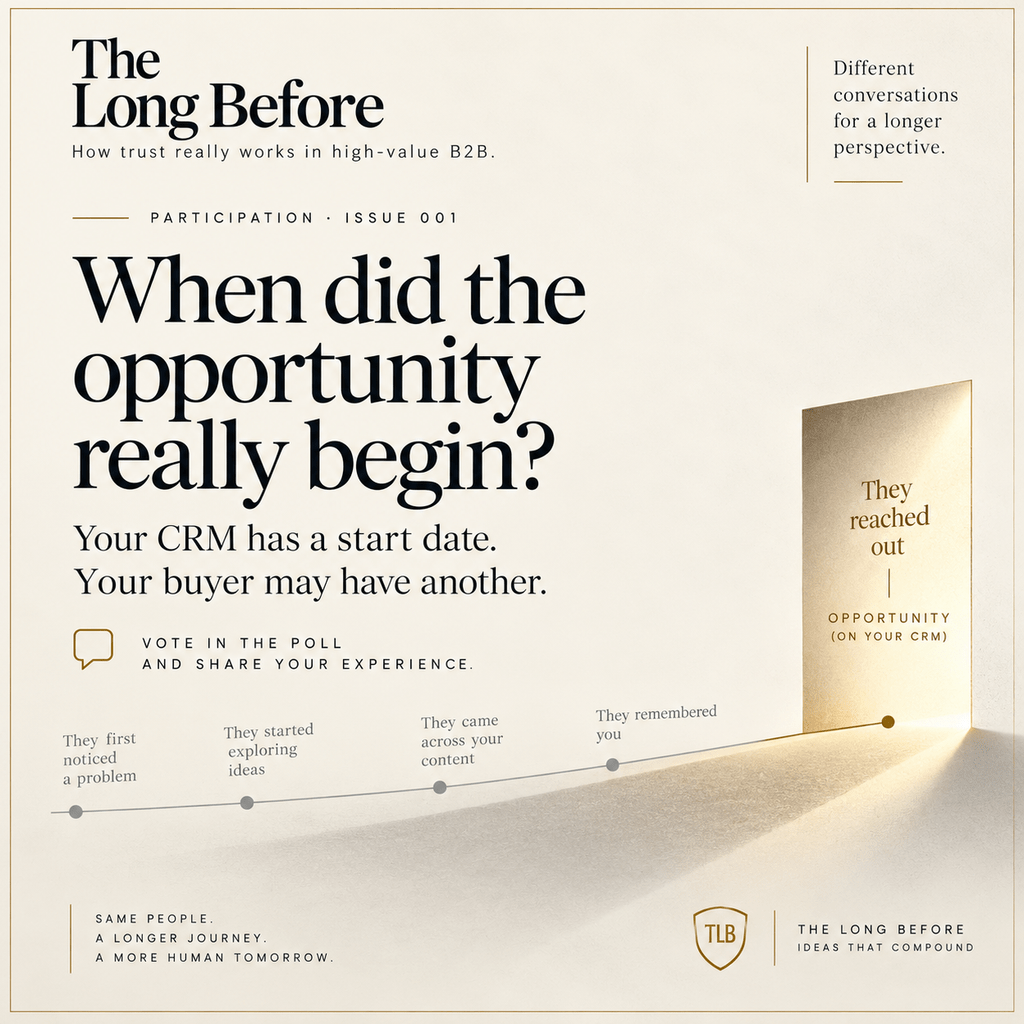
But ask the buyer when it started and you may get a very different answer.

Perhaps they first met you at an industry event four years ago.

Perhaps someone they respect has mentioned your name more than once.

Perhaps they have been seeing your thinking occasionally without ever engaging with it.

Perhaps they know one of your clients.

Perhaps you had a useful conversation two years ago that neither of you regarded as commercially significant at the time.

Or perhaps they simply knew who you were.

None of those things created an opportunity.

Then something changed.

Not necessarily with you.

With them.

A problem appeared. A priority changed. An incumbent disappointed them. A new initiative was approved.

Something that had previously been interesting but irrelevant became relevant.

And suddenly, somebody they already knew of became somebody worth speaking to.

The CRM calls Tuesday the beginning. It wasn’t. There was a long before.

Two different beginnings

Businesses need beginnings.

Sales pipelines need stages. Marketing systems need sources. Forecasts need dates. Someone needs to know when an opportunity entered the business and what happened next.

So we create a timeline:

Lead → Meeting → Opportunity → Proposal → Client

There is nothing wrong with that timeline.

But it is our timeline.

The buyer may have been living through another:

Encounter → Familiarity → Evidence → Relevance → Conversation

It won’t always happen in that order. Some of those stages may not exist at all.

But the distinction matters.

Because what appears to us as the beginning of a commercial relationship may simply be the point at which something that already existed became commercially visible.

Which raises a different question about a new opportunity.

Not only:

Where did this lead come from?

But:

What was already true before this person became a lead?

Sometimes the change is relevance, not awareness

We spend a great deal of time in B2B trying to become known to prospective buyers.

But experienced businesses often have another condition sitting quietly underneath that problem.

A lot of people already know them.

Former colleagues. Old clients. Industry peers. People met at conferences. Connections accumulated over years. People who have read something, heard something, watched something or simply encountered the company often enough to know roughly where it belongs in their mental map.

Most of those people are not prospects today.

That’s precisely the point.

They don’t need anything.

Then one day, they do.

The interesting commercial event may not be that they discovered you.

It may be that what they already knew about you suddenly became relevant.

I’ve seen a version of this repeatedly in client work.

A reconnection message goes out. There is no pitch and no immediate ask — simply a useful reason to reconnect. The recipient responds, and sometimes that response becomes a conversation.

It would be easy to say the message created the opportunity. And the message clearly mattered.

But often there was already something behind the response.

They knew the person. They knew their reputation. They had seen their work or encountered their thinking. Sometimes there was a relationship that had simply gone quiet.

The message didn’t create all of that.

It gave something already there a reason to move.

The message may have caused the conversation without having created the trust that made the conversation possible.

Think about what might sit before that moment.

A useful conversation that went nowhere.

An article read without a comment.

A client result somebody remembered.

A recommendation made when there was no immediate opportunity.

A reputation accumulated slowly enough that nobody could point to the day it was created.

None of those things needs to produce a lead today to have commercial value someday.

We simply find that value much easier to see once intent appears.

The trigger matters. It just may not be the whole story.

The same distinction matters when we try to attribute an opportunity.

The last post, email, introduction or search that preceded a response may genuinely have triggered the action.

But the trigger and the trust behind the response are not necessarily the same thing.

The last measurable touch can tell us something important about when intent became visible.

It cannot always tell us everything about why this particular person or company felt credible when that moment arrived.

That doesn’t make attribution useless.

It means the commercial history may be longer than the measurable one.

And this isn’t an argument for publishing more content.

The Long Before can contain content, certainly. But it can also contain a relationship built over ten years, a reputation inside a small industry, a client’s recommendation, an introduction from a trusted peer, a conversation that went nowhere at the time, or work somebody saw you do long before they needed you.

Nor does familiarity automatically become trust.

Someone can see your name every week for five years and still have no reason to trust you with an important problem.

Someone else can meet you yesterday through a person whose judgment they deeply trust and begin the conversation from a very different position.

Visibility is not credibility. And credibility is not necessarily trust.

What matters before a commercial conversation may be some combination of what somebody knows about you, what they have seen, what others have said, what evidence they have encountered, how relevant you seem to their problem and how much uncertainty remains.

Which is why there isn’t one universal Long Before.

Sometimes it isn’t long at all

A buyer can discover a specialist today and speak with them tomorrow.

An urgent problem can compress a buying process dramatically.

A formal procurement exercise can introduce suppliers the buyer genuinely did not know.

A strong recommendation can change the starting position almost instantly.

And sometimes the first interaction itself provides enough evidence to justify the next one.

So the argument isn’t that every B2B sale has been quietly developing for years.

“Long” isn’t a minimum duration.

The question is what — if anything — existed before the commercial moment we chose to call the beginning.

Sometimes the answer may genuinely be: almost nothing.

That’s useful to know too.

But sometimes the answer reveals that what looked like a new opportunity was actually an old relationship, an accumulated reputation, transferred trust or remembered expertise becoming relevant under new conditions.

Those are very different beginnings.

Look again at Tuesday

The meeting is still booked at 10:30.

The CRM still needs a date.

The source field still has a purpose.

The opportunity still has to be managed from this point forward.

But Tuesday means something slightly different now.

Your pipeline tells you when an opportunity became visible to you. It doesn’t necessarily tell you when you became credible to them.

So the next time a seemingly new opportunity appears, there is another question worth asking alongside “Where did this lead come from?”

What was already true before they arrived?

That feels like a good place to begin The Long Before.

And now, here is the long before.

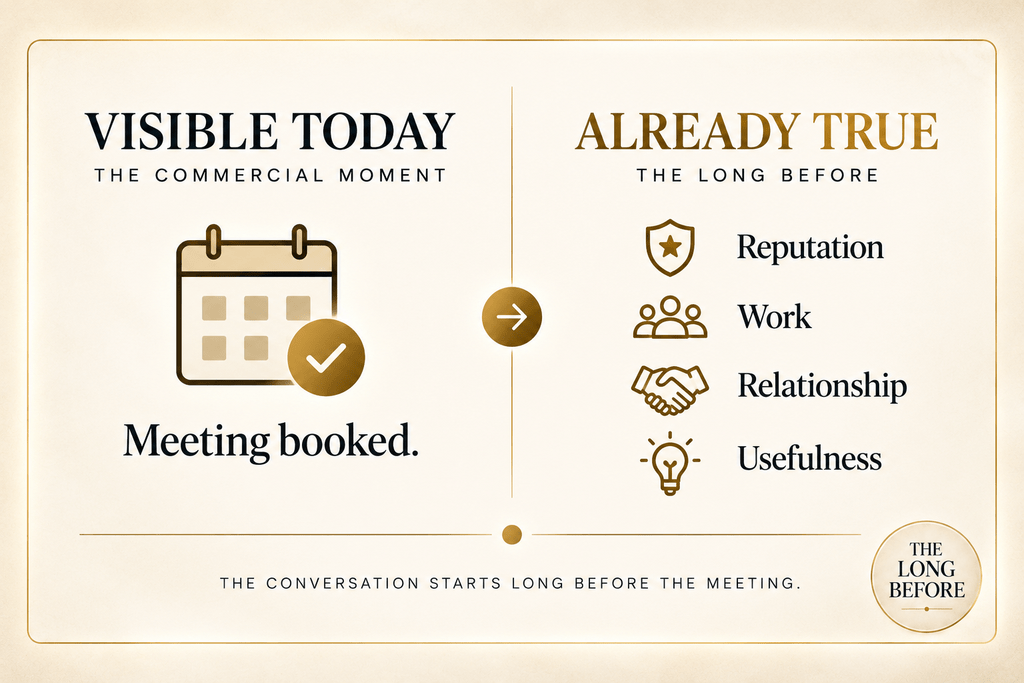
The meeting may be the first thing your pipeline can see.

But the person who booked it may have encountered your thinking, your reputation, your work, your relationships or your usefulness long before they appeared as an opportunity.

The meeting became visible today. What made it possible may have started much earlier.

That is the long before.

Join the investigation

I’m asking readers one question alongside this first issue.

Think about the last new supplier, adviser or specialist you chose to have a serious conversation with. What was already true before that first conversation?

Add your experience to the conversation → https://lnkd.in/p/g-sQ93hd

I’ll be reading the responses. Some of what we learn may find its way into a future issue of The Long Before.

(The Poll Ran from 14th to 28th September 2026) You Can see the results on the post.

Follow Future Editions On Linkedin

Read More